

The difference between manual and automated labelling comes down to three questions: what does each one truly cost, how often does each get a label wrong, and how long does automation take to pay for itself? The headline price of a labelling machine is the easy number to find. The harder, more useful number is what your current manual method is costing you once you count the wages, the rework, the line stoppages, and the price of a label that fails at a customer’s gate. This guide works through all three, using UK figures where we can, and it stays honest about the cases where manual labelling is still the right call.
We supply and integrate automated labelling for UK manufacturers and logistics operations, and we also help customers work out whether it is worth doing at all. You can see the systems we work with on our automated labelling page. The aim here is not to talk you into a machine. It is to give you a fair way to compare the two approaches on your own operation.
Key takeaways
- The true cost of manual labelling is far more than the wage. Add employer on-costs, rework, line stoppages, peak overtime, retailer deductions, and recall risk before you compare it against a machine.
- Manual application runs at roughly 300 to 500 labels an hour; automated print and apply runs into the thousands, and often lifts the whole line by clearing the end-of-line bottleneck.
- Automation sharply reduces labelling errors but does not abolish them. Machine vision verification closes the remaining gap where a single bad label is costly.
- A labelling mistake costs little at the line but a lot downstream: retailer deductions, rejected deliveries, and, at the serious end, a product recall.
- Automated labelling typically pays back within one to three years, faster where volumes, labour costs, and error costs are high.
- Manual or semi-automatic labelling is still the right answer for low or irregular volumes, very high label variability, or where labelling is not the constraint.
Table of contents
- What is the real difference between manual and automated labelling?
- What does manual labelling actually cost?
- How often does each method get a label wrong?
- What does a labelling mistake cost?
- How much faster is automated labelling?
- How quickly does automated labelling pay back?
- When is manual labelling still the right answer?
- How do you compare the two on your own numbers?
- Key terms at a glance
- Frequently asked questions
- Where Kelgray comes in
1. What is the real difference between manual and automated labelling?
The real difference is that manual labelling puts a person in the loop for every label, while automated labelling removes them. That single change is what drives every cost, speed, and accuracy difference that follows.
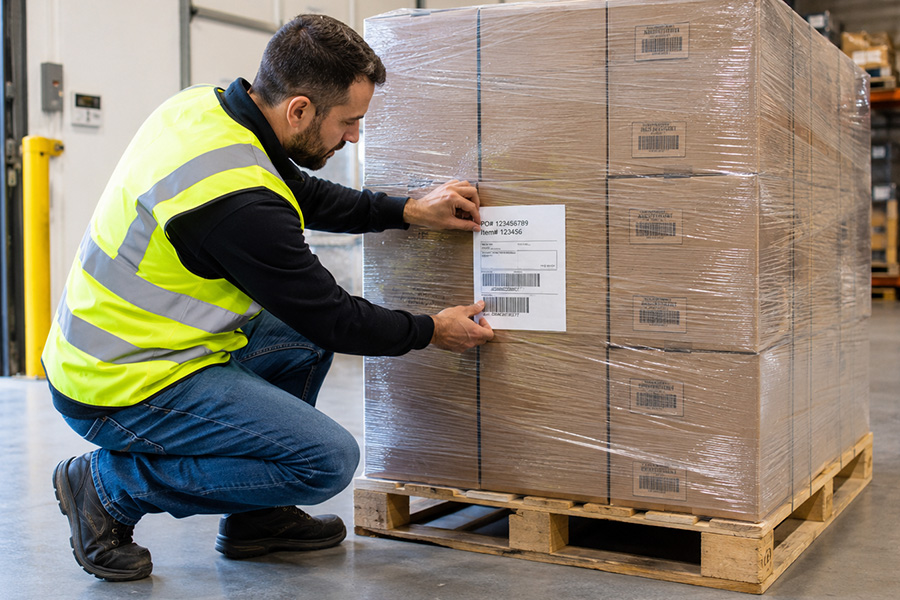
Manual labelling covers a range of methods that share one feature: a person handles the label at some point in the cycle. At the simplest, someone prints a batch of labels on a desktop or industrial printer and applies each one by hand. A step up from that is a hand-held applicator or a semi-automatic bench machine, where the operator presents each item and the device helps position or dispense the label, but a person still feeds and paces the work. Buying labels pre-printed in bulk and sticking them on by hand is another manual variant, flexible to apply but rigid on content, since the artwork is fixed before it ever reaches the line.
Automated labelling, in the form most UK operations consider, is a print and apply system. It prints each label on demand with the exact data that item needs, then applies it to the product, case, or pallet using a mechanism matched to the job, all triggered by a sensor and fed by your business systems. No one prints, peels, or places anything. If you want the full explanation of how print and apply works as a technology, we cover it in our automated labelling section. For this comparison, the important point is the loop: manual depends on a person’s pace and attention for every label, and automated does not.
It helps to picture the two as ends of a spectrum rather than a simple either-or, because the middle of that spectrum matters to the decision. At the fully manual end sits hand printing and hand application. In the middle sit semi-automatic bench applicators and hand-held devices, which take some of the effort and inconsistency out of the job while still relying on an operator to feed and pace it. At the automated end sits print and apply, where the person steps out of the cycle entirely. Many operations move along this spectrum in stages, from hand labelling to a bench unit and later to full automation, as their volumes grow. Knowing where you sit on it today is the first step in working out whether the next move along it pays.
That distinction matters because it changes what you are really buying. With manual labelling, you are paying for labour that scales with volume: more products means more hours. With automated labelling, you are paying mostly up front for equipment and integration, after which the cost per label barely moves as volume rises. The whole comparison, cost, speed, accuracy, and payback, flows from that shift from a per-label labour cost to a largely fixed capital cost.
The table below sets the two side by side at a glance. It is a starting point for the decision, not the decision itself, because the right answer always depends on your products, your volumes, and your line.
| Factor | Manual labelling | Automated (print and apply) |
| Upfront cost | Low: a printer, or a bench applicator | Higher: the system plus installation and integration |
| Cost per label as volume grows | Rises with volume (more labour) | Stays roughly flat once installed |
| Speed | Roughly 300 to 500 labels an hour by hand | Thousands an hour on a high-speed line |
| Accuracy | Depends on operator attention and fatigue | Consistent placement and data every cycle |
| Flexibility to change data | High for hand printing, low for pre-printed | High: each label prints on demand |
| Compliance (barcode grade, placement) | Variable, hard to guarantee | Repeatable, and verifiable with machine vision |
| Best fit | Low or irregular volumes, high label variety | Steady, higher volumes where errors are costly |
2. What does manual labelling actually cost?
Manual labelling almost always costs more than operations expect, because the wage on the payslip is only the first layer of a much larger stack. The visible cost is the time people spend printing, peeling, and applying labels. The costs that decide the business case are usually the hidden ones underneath it.
Start with the wage, because it is the layer everyone sees. In the UK, the National Living Wage rose to £12.71 an hour from April 2026 for workers aged 21 and over, and a warehouse or factory operative typically earns somewhere around that level, often a little above. That is the figure most people picture when they think about the cost of manual labelling. It is also the smallest part of the true cost.
The next layer is what that operator costs you as an employer, which is meaningfully more than their hourly rate. Once you add employer National Insurance, holiday pay, pension contributions, and, if the labour is supplied through an agency, the agency’s margin, the fully loaded cost of an hour of labelling is well above the headline wage. Anyone who has built a labour budget knows this, yet it rarely makes it into a quick mental comparison against a machine price.
Then come the costs that do not appear as a line on any invoice, which is exactly why they get missed:
- Rework and waste. Every skewed, missing, or wrong label that has to be peeled off and redone is paid-for time spent twice, plus the wasted label and ribbon.
- Line stoppages. When a mislabelled product is spotted, the line often stops while someone finds the problem and fixes it, which costs far more than the label itself because everything upstream waits.
- Overtime and dispatch pressure. When manual labelling cannot keep pace at peak, the usual fix is overtime or extra agency shifts, paid at a premium to hit a dispatch deadline.
- Compliance failures. A label that does not meet a retailer’s barcode or placement rules can trigger a deduction or a rejected delivery, which we look at in its own section below.
- Recall exposure. At the serious end, a mislabelled allergen or a wrong batch code can lead to a recall, whose cost dwarfs the entire labelling operation.
When we map this out with a customer, the wage is often less than half of the real cost of their manual labelling once the hidden layers are added. We are wary of putting a single percentage on that, because it varies a great deal between operations, and a neat figure would mislead more than it would help. What we can share is which costs surprise customers most when we do the mapping, and four come up repeatedly: labels applied in positions the customer’s rules will not accept, wrong labels applied through simple human error, the label waste that comes with pre-printed best-before and use-by dates, and the expense of holding a large stock of pre-printed labels, which cost more than blanks, to cover every product and date. The last two are easy to miss because they sit in the consumables budget rather than the wage bill, and they disappear when each label is printed on demand.
The cost stack below shows what we mean. The figures depend entirely on your volumes and labour rates, so treat the structure as the point, not any one number.
| Cost layer | What it includes | Often missed? |
| Direct wage | The hourly pay of the people applying labels | No, this is the visible cost |
| Employer on-costs | National Insurance, holiday, pension, agency margin | Sometimes |
| Rework and waste | Redoing wrong labels, wasted media | Often |
| Line stoppages | Lost output while a mislabel is found and fixed | Often |
| Peak overtime | Premium hours to keep pace at busy periods | Often |
| Compliance deductions | Retailer chargebacks for non-compliant labels | Usually |
| Recall exposure | The risk and cost of a labelling-driven recall | Usually |
The full method for turning this into a proper return-on-investment figure is a piece of work in its own right, and one we are glad to walk through with you when scoping a system. Here, the takeaway is simpler: before you compare manual against automated, make sure you are comparing the *true* cost of manual, rather than only the wage.
3. How often does each method get a label wrong?
Manual labelling carries a higher and less predictable error rate than automated labelling, because it depends on human attention that naturally varies with fatigue, pace, and distraction. That said, the picture is more nuanced than “machines are perfect and people are not”, and it is worth getting right.
Human error is the leading cause of labelling mistakes in manual operations. A label can be applied skewed, placed in the wrong spot, missed altogether, or carry the wrong batch, date, or destination because the data was keyed in by hand. Industry surveys give a sense of how common the consequences are. One frequently cited survey by Digimarc for Packaging World reported that 52% of manufacturers stop a production line at least once a month to deal with a mislabelling problem. That was a US survey from 2019, so we treat it as illustrative of a widespread issue rather than a precise UK benchmark, but it matches what operations tell us: mislabels are not rare events, they are a regular tax on output.
Automation reduces this sharply, because the system applies the label in the same position every cycle and prints the correct data drawn from your business systems rather than typed at the line. What it does not do is abolish error entirely. Even on automated lines, a share of labelling faults comes from mechanical causes, a worn part, a misfeed, a label that did not seat properly, and industry commentary puts that share at roughly a third of errors on modern lines. The practical lesson is that automation moves you from frequent human error to occasional mechanical error, and that the way to close the remaining gap is verification.
This is where machine vision comes in. A vision system mounted on or after the labelling head reads each label as it is applied and checks that it is present, correct, and readable, flagging or rejecting any that are not. In our own installations we treat this as standard practice rather than an optional extra: wherever label readability is critical to the customer, we fit check scanners (fixed scanners that confirm each barcode reads as it passes), vision systems, or both. That turns labelling from “apply and hope” into “apply and confirm”, and it is the natural answer where a single bad label is genuinely expensive, or where a retailer demands a minimum barcode grade. We cover this approach in our machine vision solutions section. The point for this comparison is that automated labelling is not only more accurate by default, it can be made verifiably accurate in a way hand labelling cannot.
4. What does a labelling mistake cost?
A labelling mistake costs far more than the label, because the price is paid downstream where it is most expensive to fix. The same error costs pennies at the line, pounds at your own goods-out, and potentially thousands once it reaches a customer or a regulator. This asymmetry is the single strongest argument for accuracy, and it is the part of the cost comparison that operations underweight most.
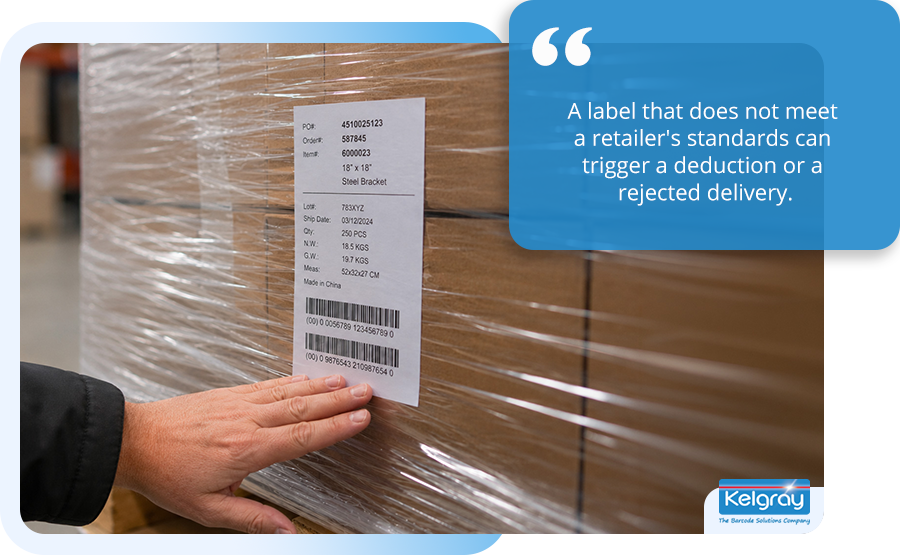
The first downstream cost is the retailer chargeback. Major retailers run supplier-compliance schemes that allow them to deduct money, or reject a delivery outright, when labels do not meet their rules, an unscannable barcode, a missing or misplaced GS1-128 logistics label, the wrong serial shipping container code on a pallet.
We want to be careful here, because the published chargeback schedules that circulate online are largely from US retailers, where a single labelling violation might cost anything from tens to a few hundred dollars per occurrence. UK grocers including the major supermarkets operate their own supplier deduction and compliance schemes, but rarely publish the rates, so we would not quote a US figure as if it were a UK one.
What we can give instead is a first-hand example from our own work. One of our customers was being charged £500 for every pallet a large UK supermarket chain rejected over labelling, a cost that repeated with every failed delivery. We fitted fixed-position check scanning on their line, with handheld check scanning covering the labels still printed manually, and the charges went from £500 a pallet to zero.
The wider point stands: non-compliant labelling carries a real, recurring, per-occurrence cost in UK retail supply, and it is precisely the kind of error automated, verified labelling is built to prevent. The compliance rules themselves, the GS1 logistics label and barcode grading, are covered in our pallet and logistics labelling pages.
The second, and far larger, cost is the product recall. Recalls driven by labelling errors, a missed allergen, a wrong ingredients list, an incorrect batch code, are both serious and rising in the UK. One analysis of Food Standards Agency recall notices counted 141 product recalls in 2025, a clear rise on the year before, with 85 allergen alerts issued across England, Wales and Northern Ireland in the same year, roughly one every four days (Food Standards Scotland reports separately).
Allergen labelling errors are consistently the leading single cause of UK food recalls. The financial cost of any individual recall varies too much to put a reliable figure on, but it always includes recovering and disposing of stock, halting and checking production, reprinting, lost retailer listings, and reputational damage that outlasts the incident. For a food or pharmaceutical operation, this single risk often justifies the move to automated, verified labelling on its own.
| ⚠ Where a labelling error gets expensive
• A barcode below the customer’s required grade, triggering a deduction or rejected delivery • A misplaced or missing GS1-128 pallet label, failing a retailer’s goods-in • An allergen or ingredients error on food prepacked for direct sale, risking a recall • A wrong batch or date code, breaking traceability when you most need it |
| Not sure what mislabelling is really costing you?
Tell us what you make, the volumes you run, and where labels are slowing you down or going wrong, and we will help you map the true cost of your current method. Speak with a specialist. |
5. How much faster is automated labelling?
Automated labelling is faster than manual labelling by an order of magnitude, and the gap matters most because manual labelling often sets the ceiling for the whole line. Speed is the most visible difference between the two, though it is rarely the one that decides the business case on its own.
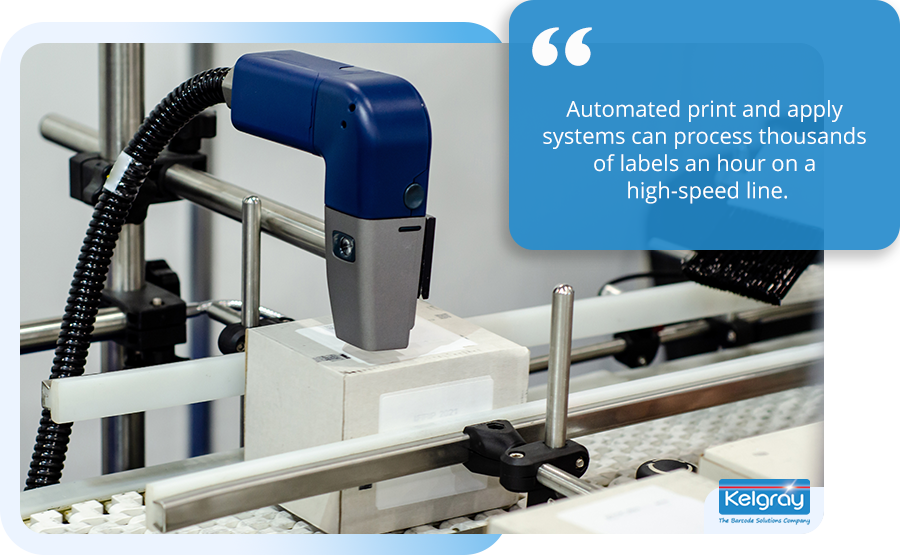
By hand, an operator applies somewhere in the region of 300 to 500 labels an hour, which works out at roughly five to eight a minute, depending on the product and how reliably it is presented. A semi-automatic bench applicator lifts that into the low tens per minute, because the machine handles the dispensing while the operator still feeds each item. Automated print and apply systems operate in a different range altogether, running into the thousands of labels an hour on a high-speed line. The exact rate depends on the product, the label, and the application method, so these are orders of magnitude rather than guaranteed specifications, but the difference is real and large.
The reason this matters is the ceiling effect. When labelling is the slowest step at the end of a line, it caps how fast everything upstream can usefully run, no matter how quick the rest of the process is. The pattern we see on the lines we commission is that freeing the labelling bottleneck often lifts the output of equipment that was never the real constraint, because the end of the line stops holding it back. For an operation that is hitting its dispatch capacity, that recovered throughput can matter more than the labour saving, since it lets you grow volume without growing the building or the shift pattern.
There is a second, quieter speed difference that the headline rates miss: consistency. A person labelling by hand does not run at a steady rate all shift. The pace drops with fatigue, after breaks, and under the pressure of a late dispatch, which is the moment errors tend to climb as well. An automated system holds the same rate from the first label to the last, so its real-world output is closer to its rated speed than a manual station’s is to its best hour. When you compare the two, it is fairer to weigh automated speed against a manual operation’s *average* rate across a full shift, not its fastest burst, because the average is what actually fills the lorry.
6. How quickly does automated labelling pay back?
Automated labelling typically pays back within one to three years, and faster, sometimes inside a year, where label volumes are high, labour costs are significant, and manual errors are expensive. The range is wide because the payback depends almost entirely on your numbers, not on an industry average.
The figures published by machine suppliers tend to flatter the fast end of that range, because they are selling machines. We prefer to set expectations on the wider one to three year band and then work out where your operation sits within it. What moves payback within that band is straightforward, and it is worth checking where your operation sits before costing a system in detail.
One project of our own shows the fast end of that band in practice. A flower bouquet producer was labelling every bouquet sleeve by hand across 14 production lines, which took 20 staff working eight-hour days on application, plus a three-person print room printing all the labels offline. We automated the lines with print and apply systems using tamp-blow application, where the applicator pad carries each label to the product and a burst of air places it. The investment paid back in 12 months. We would not promise that speed to every operation, because few carry that much labelling labour, but it shows how quickly the numbers move when the labour displaced is large.
| Payback comes faster when… | Payback comes slower when… |
| Label volumes are high, so the fixed cost spreads over more units | Volumes are low or irregular |
| The fully loaded labour cost is high, so automation saves more per hour displaced | Daily run times are short |
| The line runs long hours, keeping the system earning | Labels vary so much that set-up eats the gain |
| Errors are expensive, so accuracy is worth more (chargebacks, recall exposure) | — |
In the business cases we build with customers, the most reliable payback comes from combining the labour saving with the error and rework saving, rather than relying on labour alone. A system justified only on displacing one operator can look marginal; the same system justified on labour, plus the rework it removes, plus the chargebacks and recall risk it prevents, usually looks far stronger. The full calculation, with the formula and the inputs to gather, is the natural next step once this comparison has told you automation is worth costing properly, and it is something we are glad to work through with you directly.
| What shapes the payback
1 to 3 years — the common payback range for automated labelling, faster where volumes and error costs are high 12 months — the payback on our own flower-bouquet project, replacing hand labelling across 14 production lines £12.71 — UK National Living Wage per hour from April 2026, the base of the labour-saving calculation |
7. When is manual labelling still the right answer?
Automation makes sense where volumes are steady and high enough, where labels change often enough that the flexibility pays, and where the cost of an error is real. Outside those conditions, a simpler method is often the better call for now.
Three situations point towards staying manual or semi-automatic. The first is low or irregular volume: if you label modest quantities, or in unpredictable bursts, the labour saving may never cover the system cost, and a hand or bench method keeps your flexibility. The second is very high label variability: an operation running short runs of constantly changing products can spend more time setting up an automated line than it saves, though good integration narrows this gap. The third is labelling not being the constraint: if your bottleneck and your errors sit elsewhere, automating a step that is already keeping up frees no real capacity and fixes no real problem.
There is also a sensible middle path that this comparison should not skip. For an operation that is outgrowing hand labelling but not yet ready for full automation, a semi-automatic bench applicator can be the right step, taking the worst of the inconsistency out of the job at a fraction of the cost and commitment of a full print and apply line. It still needs an operator, so it does not deliver the labour saving or the unattended speed of automation, but it can steady accuracy and ease a bottleneck while volumes build towards the point where full automation pays. We would rather point a customer to the right step on the spectrum than push them past it.
None of these positions is permanent. Volumes grow, product mixes settle, and a manual method that is right today can become the bottleneck next year. The sensible approach is to revisit the comparison when one of your drivers changes materially, rather than treating the decision as a one-off. When we advise a customer to stay manual for now, we say what would need to change for automation to make sense, so the decision is easy to revisit later.
8. How do you compare the two on your own numbers?
You compare them by costing your *current* method honestly first, then setting that against the system and what it would save, rather than comparing a machine price against a wage. Working the decision in a fixed order keeps it grounded in your operation instead of an industry average.
| Step 1
Cost manual fully |
Step 2
▶ Count the errors |
Step 3
▶ Measure the speed gap |
Step 4
▶ Price the system |
Step 5
▶ Compare on payback |
Take those in turn. Cost manual fully by adding the hidden layers, employer on-costs, rework, stoppages, overtime, compliance deductions, to the wage, so you have the true figure rather than the visible one. Count the errors you currently absorb, how often you rework labels, stop the line, or get pulled up by a customer, and put a cost against them. Measure the speed gap by checking whether manual labelling is capping your line, because recovered throughput is part of the return. Price the system including installation, integration, and the consumables it runs on, rather than the hardware alone. Then compare on payback, setting the fully costed manual method against the system and its combined labour, error, and throughput savings.
If that points towards automation, the next step is to turn these factors into a firm specification and a proper return-on-investment figure, which is exactly what we help customers do when scoping a system. If it points towards staying manual, you will know exactly which number would have to move to change the answer.
9. Key terms at a glance
The glossary below collects the terms used through this guide, for quick reference.
| Term | What it means |
| Manual labelling | Any method where a person prints, peels, or applies labels by hand or with a hand-fed device |
| Print and apply | An automated system that prints each label on demand and applies it without a person |
| Fully loaded labour cost | The real cost of an employee: wage plus employer National Insurance, holiday, pension, and agency margin |
| Rework | Peeling off and redoing a wrong label, paying for the same task twice |
| Chargeback | A deduction a retailer makes when a delivery fails its labelling or compliance rules |
| SSCC / GS1-128 | The serial shipping container code and the barcode that carries it on a logistics label |
| Barcode grade | A printed barcode’s scannability scored A to F under ISO/IEC 15416:2025; retailers often require Grade B or better |
| Machine vision verification | An automated check that reads and confirms each label as it is applied |
| Payback period | The time it takes for the savings from automation to cover its cost |
10. Frequently asked questions
Is automated labelling worth it for a small business? It can be, but not always. Automated labelling suits both SMEs and larger operations where volumes are steady and labelling errors are costly. For very low or irregular volumes, a hand or semi-automatic method is often the better value until volumes grow. The reliable test is to cost your current manual method fully and compare it against the system, rather than assuming size alone decides it.
How do you calculate the payback on automated labelling? You set the fully loaded cost of your current manual labelling, the wage plus employer on-costs, rework, stoppages, and error costs, against the cost of the system and what it saves. Payback commonly lands within one to three years, faster where volumes and error costs are high. The dependable way to know your own figure is to build the case from your own numbers, which we are glad to work through with you when scoping a system.
How much faster is automated labelling than manual? Roughly an order of magnitude. Hand application runs at about 300 to 500 labels an hour, a semi-automatic bench unit reaches the low tens per minute, and automated print and apply systems run into the thousands an hour on a high-speed line. The exact rate depends on the product, label, and method, so treat these as broad ranges rather than fixed specifications.
Does automated labelling remove labelling errors completely? It reduces them sharply but does not abolish them. Automation removes most human error by applying labels consistently and printing the right data automatically. A smaller share of mechanical faults can remain, which is why machine vision verification is used where a single bad label is genuinely costly, checking each label as it is applied.
What does manual labelling really cost on top of wages? The wage is often less than half the true cost. The rest sits in employer on-costs, rework and wasted media, line stoppages to fix mislabels, peak overtime, retailer chargebacks for non-compliant labels, and the risk of a labelling-driven recall. Counting only the wage is the most common reason operations underestimate what their current method costs.
11. Where Kelgray comes in
A comparison like this is only worth doing if the numbers behind it are real, and that is where we tend to help most. We supply and integrate automated labelling for UK manufacturers and logistics operations, and a good deal of that work is sitting down with a customer to cost their current method properly before anyone mentions a machine.
Because the labeller, the labels and ribbons, and the machine-vision checks come from us as one package, they are matched to each other from the start, which strips out a cost most buyers never price in: the rejects and the finger-pointing that come from stitching several suppliers together. We have done this for UK businesses since 1972, our work carries ISO 9001 and SafeContractor accreditation.There is more about us on our site.
If this comparison has you leaning one way or the other, the natural next step is to put your own figures against it with us. We will look at your volumes, your labour and error costs, and where labelling sits on your line, and tell you plainly whether automation pays, or whether staying manual is the better call for now.
| Speak with a specialist about your labelling
Tell us your products, your volumes, and what labelling is costing you today, and we will help you compare manual against automated on your own numbers. Speak with a specialist. |
Sources
- UK Government, National Living Wage and National Minimum Wage rates (rate of £12.71 per hour for workers aged 21 and over from April 2026).
- PayScale and Indeed, UK warehouse worker and factory worker hourly pay data, 2026.
- Dockside Personnel, commentary on total employer staffing costs (wage plus employer National Insurance, holiday accrual, and agency margin), 2026.
- Digimarc / Packaging World, 2019 US manufacturer survey on production-line stoppages for mislabelled product (52% shut down a line at least once a month).
- Sessions UK, commentary on the share of labelling errors attributable to mechanical misalignment on modern lines (~35%), 2025.
- Weber Packaging Solutions, label application speed chart; CTM Labeling Systems, Resource Label Group and PackLeader, manual versus automated application speeds.
- Food Standards Agency, recalls and alerts (Allergy Alert numbering; the FSA reports incidents on a financial-year basis); industry analysis of FSA recall notices for the 2025 calendar-year totals (FoodHygieneCertificate.co.uk) — figures vary with counting methodology.
- GS1 UK, logistics label, SSCC and GS1-128 guidance; ISO/IEC 15416:2025 (1D barcode print-quality grading; current edition, published January 2025).
- Industry ROI commentary on automated labelling and packaging payback ranges (Viastore/Food Logistics, Quadrel, Litianpacking, AMD Machines), used as benchmark ranges, not independent data.