

The main benefits of automated labelling come down to three things: it labels faster, it gets the label right more often, and it ties every label back to a record you can trace. Most buyers come to automation for one of those three and discover the other two arrive with it. A food producer wants traceability and finds the line runs faster too. A 3PL wants throughput and finds its barcode rejections fall away. This guide takes each benefit in turn, explains the mechanism behind it rather than just asserting it, shows where on the line you feel it, and stays honest about what it takes to realise all three.
We supply and integrate automated labelling for UK manufacturers, food producers, and logistics operations, so most of what follows is drawn from what these systems do once they are running on a real line, not from a specification sheet. You can see the systems we work with on our automated labelling page. The aim is to give you a clear, fair picture of what automating labelling delivers, so you can judge whether those benefits matter enough on your operation to be worth costing properly.
Key takeaways
- Automated labelling delivers three core benefits at once: higher throughput, better accuracy, and stronger traceability.
- Throughput rises because the label is applied in a fixed cycle with no person to pace it, which lifts both the labelling rate and the output of the whole line waiting behind it.
- Accuracy improves because the data is printed straight from your systems and each label can be verified to a barcode grade, rather than just hoped to be right.
- Traceability comes from tying every label to its system record, so a batch can be traced forward to customers and backward to suppliers fast for an audit or a recall.
- The three benefits compound, so the strongest result comes from scoping the applicator, verification, consumables, and system integration together rather than buying the machine alone.
Table of contents
- What are the benefits of automated labelling?
- How does automated labelling improve throughput?
- Does automated labelling reduce labelling errors?
- How does automated labelling improve traceability?
- How do the three benefits compound?
- Where do these benefits matter most across UK operations?
- What stops automated labelling from delivering these benefits?
- Key terms at a glance
- Frequently asked questions
- Capturing all three with Kelgray
1. What are the benefits of automated labelling?
The benefits of automated labelling group into three: higher throughput, better accuracy, and stronger traceability. Throughput is the speed and capacity benefit, accuracy is the error-reduction benefit, and traceability is the record-keeping benefit that links each label to the batch, system, and supply chain behind it. Most other advantages people list, less rework, fewer chargebacks, calmer peak periods, faster recalls, are downstream effects of these three.
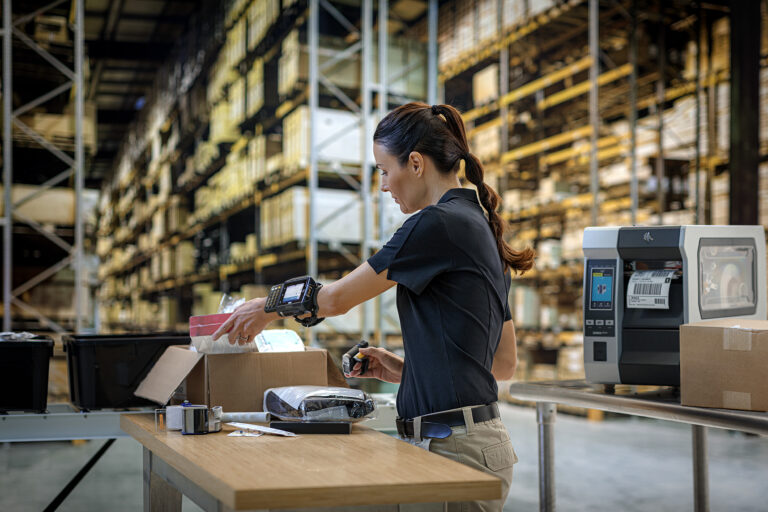
It is worth being clear about what “automated labelling” means here. We use it to mean a print and apply system: a machine that prints each label on demand with the exact data that item needs, then applies it to the product, case, or pallet without a person handling it, triggered by a sensor and fed by your business systems. That is different from buying labels pre-printed and sticking them on by hand, and different again from a semi-automatic bench applicator where an operator still feeds each item. If you want the full explanation of how print and apply works as a technology, we cover it in our automated labelling section. For this guide, the key point is that removing the person from the labelling loop is what unlocks all three benefits at once.
The three rarely arrive evenly. One usually matters most to a given operation, and it tends to be the one that drove the enquiry. What surprises people is how much the other two are worth once the system is in. The table below sets out each benefit, the mechanism behind it, where you feel it on the line, the symptom it removes, and how you would measure or verify it. We come back to each row in detail through the rest of the guide.
| Benefit | What drives it | Where you feel it on the line | The symptom it removes | How it is measured or verified |
| Throughput | The label is printed and applied in a fixed cycle, with no person to pace it | The end-of-line station, and everything upstream that was waiting on it | Labelling capping the line; overtime to clear a backlog | Labels per hour, and the line’s output per shift |
| Accuracy | Data is pulled from your systems and the label is placed the same way every cycle | The print head and the point of application | Skewed, missing, or wrong labels; failed barcode grades | Barcode grade (ISO/IEC 15416) and machine vision verification |
| Traceability | Each printed label is linked to the system record behind it | The data link to your ERP, WMS, or MES | Re-keyed data; batch codes that drift from the record | The ability to trace a batch forward and backward on demand |
2. How does automated labelling improve throughput?
Automated labelling improves throughput by removing the person who placed every label, which lifts both the labelling rate itself and, more importantly, the output of the whole line that was waiting on it. Speed is the most visible of the three benefits, and for some operations it is the only reason they look at automation at all.
Start with the raw rate. Applying labels by hand, an operator manages somewhere in the region of a few hundred an hour, with figures around 300 an hour commonly cited for manual application, depending on the product and how reliably it can be presented. A semi-automatic bench applicator lifts that, because the machine handles the dispensing while the operator still feeds each item. Automated print and apply systems run in a different range altogether, from the low hundreds of labels an hour up into the thousands on a high-speed line, with vendor figures of several thousand an hour quoted for fast bottle and carton lines. The exact rate depends on the product, the label, and the application method, so these are orders of magnitude rather than guaranteed specifications. In short, automation moves labelling speed up by an order of magnitude or more, not by a few percent.
A bottle-labelling project of ours shows what that looks like in practice. Labelling bottles by hand is slow work, because each label must be placed and aligned by eye, and the operation in question had multiple people doing exactly that across 8-hour shifts. The right machine for the job was a line-integrated automated labeller, and it now labels 1,500 bottles an hour, applying every label in the same position at the same rate from the first bottle to the last. That is the kind of jump a hand-labelling station cannot close by working harder.
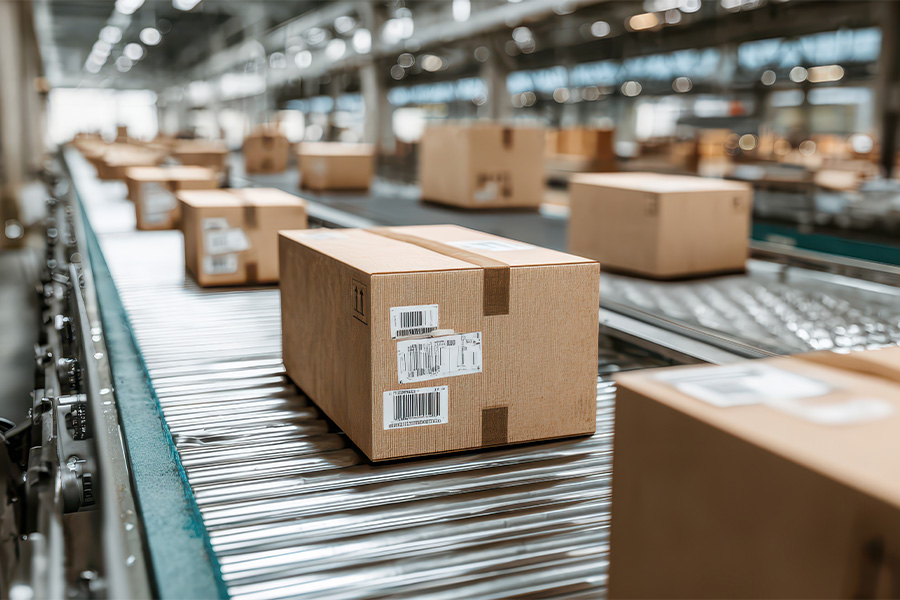
The raw rate, though, is rarely the number that matters most. The bigger throughput benefit is what happens to the rest of the line. Labelling usually sits at or near the end of a process, after the product is made, filled, or picked. When labelling is the slowest step, it sets a ceiling on how fast everything upstream can usefully run, because output can only leave as fast as it can be labelled and dispatched. A faster filler or a quicker pick face does not help if cartons then queue at a hand-labelling station. This is the ceiling effect, and it is why a labelling bottleneck is so expensive: it wastes capacity you have already paid for elsewhere.
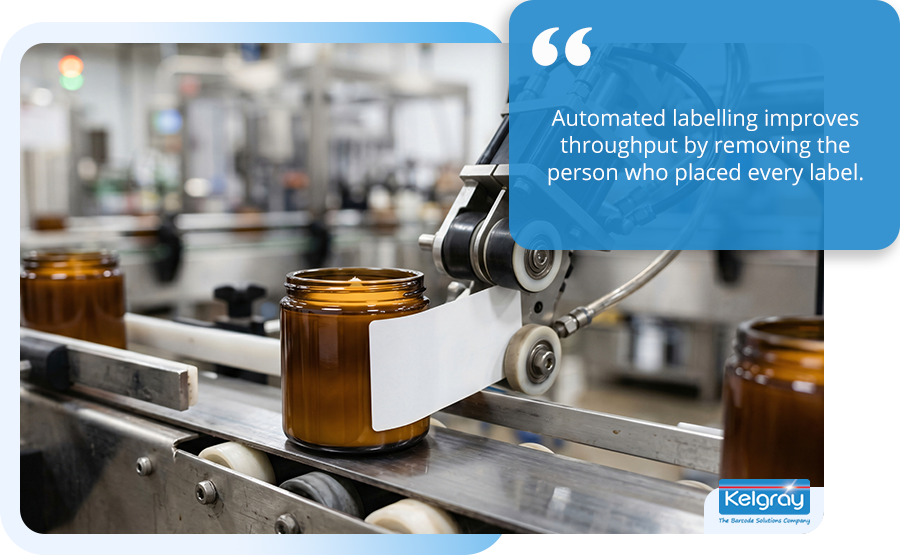
Automating that step turns labelling from a variable, person-paced bottleneck into a timed station that keeps up with the flow. The pattern we see on the lines we commission is that freeing the labelling bottleneck often lifts the output of equipment that was never the real constraint, because the end of the line stops holding it back. For an operation hitting its dispatch capacity, that recovered throughput can matter more than the labour saving, because it lets you grow volume without growing the building or adding a shift. A 3PL keeping pace with next-day shipping, or a food line feeding a retailer’s delivery window, feels this benefit first.
There is also a second, quieter speed benefit: consistency across a shift. A person labelling by hand does not run at a steady rate all day. The pace drops with fatigue, after breaks, and under the pressure of a late dispatch, which tends to be the moment errors climb as well. An automated system holds the same rate from the first label to the last, so its real output sits close to its rated speed, while a manual station’s average across a full shift is well below its best hour. When you weigh the two, it is fairer to compare automated speed against a manual operation’s average rate across the shift, not its fastest burst, because the average is what fills the lorry. The table below sets the speed picture out plainly.
| Method | Typical application rate | What paces it | Output across a full shift |
| Hand application | Around a few hundred labels an hour | The operator’s pace and attention | Well below the best hour, falling at peak |
| Semi-automatic bench applicator | Higher, into the low tens per minute | The operator still feeds each item | Steadier, but still operator-bound |
| Automated print and apply | Into the thousands an hour on a fast line | The system cycle and the conveyor | Close to the rated rate, held all shift |
This is also where automation connects to a wider pressure. Make UK estimated in 2025 that the sector’s skills shortage, with around 55,000 long-term unfilled vacancies, costs UK manufacturing roughly £6bn a year in lost output, and sector productivity has been hard to lift consistently over the past decade. Against that backdrop, recovering throughput from a step that no longer needs a person to pace it is one of the more direct productivity gains an operation can make. Whether the labour saving alone justifies the spend is a separate question, and one we deliberately hand to a full cost and ROI comparison rather than answer here.
| Wondering whether labelling is capping your line?
Tell us what you make, the volumes you run, and where things back up at the end of the line, and we will help you work out how much throughput is sitting behind your labelling step. Speak with a specialist. |
3. Does automated labelling reduce labelling errors?
Automated labelling does reduce labelling errors, and it does so in two ways: by removing the manual steps that cause most mistakes, and by making accuracy something you can verify rather than hope for.
Most labelling errors in a manual operation come from one of two places: the data and the application. On the data side, a label can carry the wrong batch, date, or destination because the information was keyed in by hand or the wrong pre-printed label was picked. On the application side, a label can go on skewed, in the wrong place, or be missed altogether. Both are human-attention problems, and human attention varies with fatigue, pace, and distraction in exactly the way machines do not.
Automation addresses both at source. The data is pulled straight from your business systems and printed on demand, so the label carries what the record says rather than what someone typed at the line. The application is mechanical and repeatable, so the label lands in the same position every cycle. That removes the bulk of human error in one step. What it does not do is abolish error entirely. Even on automated lines, a residual share of faults comes from mechanical causes, a worn part, a misfeed, a label that did not seat properly, and industry commentary suggests mechanical issues account for a meaningful share of the errors that remain. The practical lesson is that automation moves you from frequent human error to occasional mechanical error, and that the way to close the remaining gap is verification.
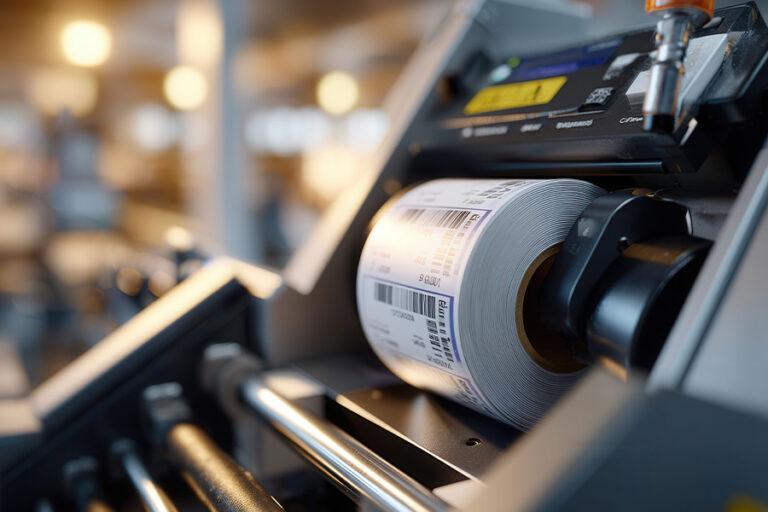
This is where barcode grading and machine vision come in, and where automated accuracy becomes provable. A printed barcode is not simply readable or unreadable; its print quality is graded on a five-point scale from A (best) to F (fail), with no grade E, under ISO/IEC 15416 for linear barcodes and ISO/IEC 15415 for 2D codes, assessed across parameters such as contrast, modulation, and decodability.
Most major retailers and logistics providers require suppliers to meet a minimum grade, often Grade B or better, so that codes scan reliably right through the supply chain. A barcode that scans fine on your bench can still fail at a customer’s goods-in if its grade is marginal. Automated printing, with the right label and ribbon match, produces consistent, repeatable print quality in a way hand methods struggle to guarantee.
Verification closes the loop. A machine vision system mounted on or after the labelling head reads each label as it is applied and checks that it is present, correct, and readable, flagging or rejecting any that are not. That turns labelling from “apply and hope” into “apply and confirm”, and it is the natural answer where a single bad label is genuinely expensive or where a customer demands a minimum barcode grade.
We built exactly this into a seal-labelling line, pairing the vision check with a high-speed reject so that any misaligned, mispositioned, or missing seal label was pulled from the flow before it could be packed. The customer felt the result downstream, in fewer returns and fewer fines from the supermarket the line supplied, because the labels that used to trigger them no longer left the building. We cover this approach in our machine vision solutions section. The point for this guide is that automated labelling is not only more accurate by default, it can be made verifiably accurate, which is something a hand-labelling station cannot offer however careful the operator.
It is worth stressing that accuracy and the right consumables go together. A verification system can only confirm a label that was printed well in the first place, and print quality depends on matching the label material and the thermal transfer ribbon to the job and the surface. This is one reason we supply the labels and ribbons alongside the labeller rather than leaving them as someone else’s problem: a mismatched consumable is a common, quiet cause of barcode grades drifting below the line a retailer will accept.
4. How does automated labelling improve traceability?
Automated labelling improves traceability by making each printed label a reliable link to the system record behind it, so the batch, lot, date, and serial on the label always match what your business systems hold. Traceability matters in food, drink, pharmaceutical, and regulated supply, because it is what lets you answer “where did this come from and where did it go” quickly and with confidence.
The mechanism is the data link. An automated labelling system pulls its data in real time from your ERP, WMS, or MES, rather than relying on a person to select or type it. That means the batch code printed on the pack is the batch code in the system, not a separate, hand-entered version that can drift from it. When the label is the system’s own output, the record and the physical product stay tied together by design. We cover the systems side of this in our software solutions and bespoke software integration work, because connecting the labeller to the business systems is usually where the traceability benefit is won or lost.
Connecting a print and apply system to a customer’s ERP or WMS is routine work for us. Where no built-in integration exists, our in-house developers supply the software integration or middleware to make the link, and where a job calls for it, the setup can still allow an operator to enter specific label information at the time of print. The result streamlines the label data, cuts operator error, and can even write data back to the customer’s own system, so the information flows both ways rather than stopping at the printer.
What the label carries matters as much as where its data comes from. A modern logistics or product label does more than print a price and a name. A GS1-128 barcode or a 2D code such as a Data Matrix can carry the Global Trade Item Number, the batch or lot number, the production and expiry dates, and a serial shipping container code for a pallet, all as machine-readable data using GS1’s application identifiers. When that data is scanned at goods-in, it can be parsed and committed straight into the receiving system as the authoritative record, with no re-keying. The label stops being a sticker and becomes the carrier of the traceability record itself.
The table below shows the kind of data a well-built automated label can carry and what each piece does for traceability.
| Data carried | What it identifies | Why it matters for traceability |
| GTIN (Global Trade Item Number) | The product itself | Ties the item to its specification and master data |
| Batch / lot number | The production run | Lets you isolate a single run if something goes wrong |
| Production and expiry dates | When it was made and its shelf life | Supports rotation, shelf-life rules, and date-based recall |
| SSCC (serial shipping container code) | The individual pallet or unit load | Tracks a specific pallet through the supply chain |
| Serial number | The individual item | Underpins item-level traceability where it is required |
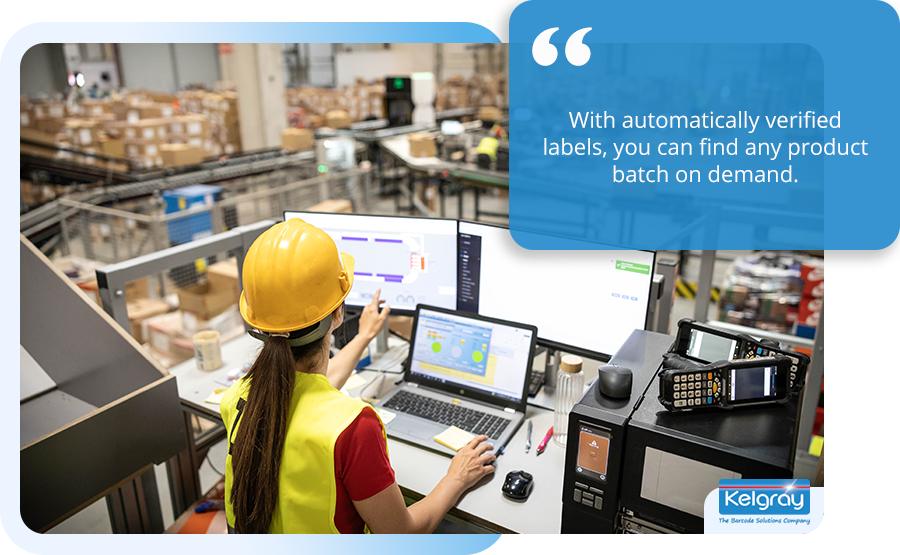
The payoff arrives when something goes wrong. If a problem is found, an integrated, well-labelled operation can trace affected batches forward to the customers who received them and backward to the suppliers and materials that went into them. That narrows a recall from “everything we made that week” to “this batch, sent to these customers”, which cuts both the cost and the reputational damage.
A chemical supplier we work with shows the principle in action: it can now trace a suspect batch from the GS1 barcode alone, because the number the label carries encodes the production date, the production line, and which of the site’s three 24-hour shifts made the product, all captured automatically with no operator input. The questions a trace used to open with are answered by the label itself. It also speeds up the everyday demands that are not recalls at all: a retailer audit, a due-diligence check, a customer query about a specific delivery. The faster you can answer with confidence, the less a query costs you in time and standing.
The stakes here are not abstract for UK operations, particularly in food. Analysis of UK recall data found 141 product recalls in 2025, around 23% more than the 115 recorded in 2024, with 85 allergen alerts issued in 2025, roughly one every four days. Allergen labelling errors are consistently the leading single cause: an RQA Group analysis put them at around a third of Food Standards Agency alerts in the first half of 2025, and they remained the leading single cause across the year. Strong traceability does not prevent every one of those, but it is what limits the damage when a labelling or allergen problem does occur, by letting you find and contain the affected product fast. The compliance rules that sit behind this, the GS1 logistics label, barcode grading, and the food labelling law itself, are a topic in their own right, and we treat them separately rather than fold them in here.
| Why traceability is worth the attention
141 — UK product recalls in 2025, around 23% up on the 115 in 2024 85 — allergen alerts issued in the UK in 2025, roughly one every four days A third — allergen labelling’s share of UK food-safety alerts in the first half of 2025 (RQA Group), the leading single cause |
5. How do the three benefits compound?
The three benefits compound because each one depends on and reinforces the others, so an operation that captures all three gets more than the sum of the parts. A faster line is only worth having if the labels are right; an accurate label is only fully useful if it ties back to a record; a traceable record is only trustworthy if the label that carries it was applied and verified correctly. Treat them as one connected outcome and they support each other; treat them as three separate purchases and you can end up with one without the value of the others.
The simplest way to see it is to follow a single product through the line, where each benefit hands off to the next.
| Step 1
Apply at line speed |
Step 2
▶ Verify the label is right |
Step 3
▶ Link it to the record |
Step 4
▶ Trace or recall fast |
Take those in order. Apply at line speed is the throughput benefit: the label goes on in a fixed cycle that keeps up with the flow. Verify the label is right is the accuracy benefit: the system confirms the label is present, correct, and to grade before the product moves on. Link it to the record is the traceability benefit at the point of creation: the data on that verified label matches the batch and order in your systems. Trace or recall fast is the traceability benefit paying out later: because every label was applied, verified, and linked, you can find any batch on demand. Skip a step and the chain weakens. A fast line with no verification just makes mistakes more quickly. A verified label with no system link is accurate but hard to trace. The benefit is the whole sequence holding together.
This is also why we are wary of selling the three in isolation, and why we tend to look at the whole end of a line rather than a single machine. An applicator on its own delivers throughput. Add verification and you protect accuracy. Connect it to the business systems and you gain the traceability. Each layer makes the previous one worth more. An operation that buys only the applicator and skips the rest often comes back later wondering why barcode grades still drift or why a trace still takes a morning of spreadsheet work, and the answer is usually that one of the links in this chain was left out.
6. Where do these benefits matter most across UK operations?
These benefits matter most where the cost of the corresponding problem is highest, which varies by sector and operation. The same automated line delivers all three, but which one tips the decision depends on what preoccupies the operations manager.
For food and drink producers, traceability usually leads, with throughput close behind on the biggest lines. Allergen labelling, batch coding, and date accuracy carry real legal and recall risk, and retailers audit hard against them, so the ability to print the right data from the system, verify it, and trace a batch fast is often what gets a project approved.
Across the product-labelling work we do for food, beverage, and pharmaceutical customers, the same pair comes up again and again: the large producers run high-speed lines, and what they ask of the label is consistent, well-aligned placement, a shelf-ready presentation, and legible customer-facing print such as the best-before date, applied at a rate hand labelling could never hold.
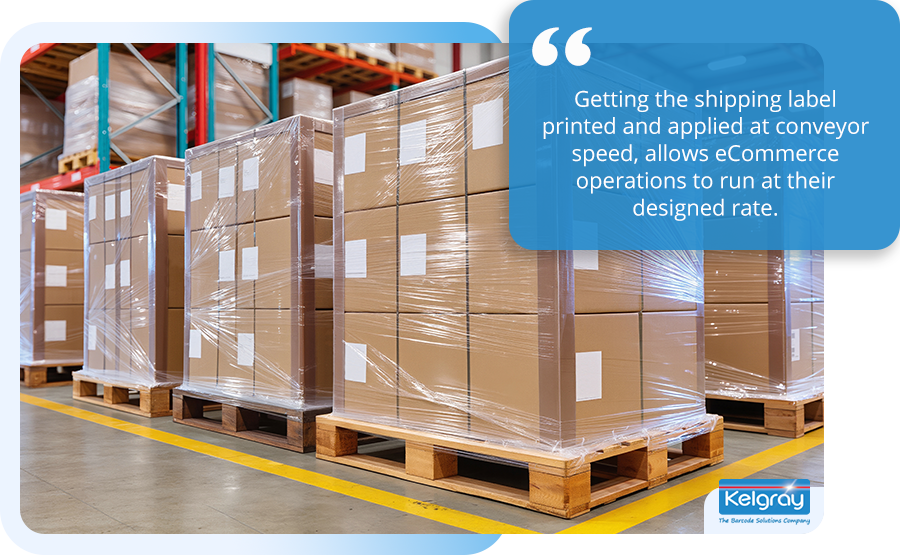
For e-commerce operations and third-party logistics providers, throughput usually leads. The pressure is next-day and same-day shipping, and labelling at the end of a pick-and-pack or sortation line is a classic bottleneck. Getting the shipping label printed and applied at conveyor speed, with the right address and barcode every time, is what lets the whole operation run to its designed rate. Accuracy follows close behind, because a mis-scanned or wrong shipping label turns into a misdelivery and a costly return.
For manufacturers supplying retailers, accuracy and compliance often lead. Retailer chargebacks and rejected deliveries for non-compliant labels, an unscannable barcode, a misplaced logistics label, a marginal grade, are a recurring, per-occurrence cost, and verified automated labelling is built precisely to prevent them. Traceability supports the same goal by making audits and queries quick to answer. That matches the pattern across our own outercase and pallet labelling work, where the priorities are print quality and label placement, because the case or pallet label must meet the customer’s stated constraints and requirements to be accepted at goods-in.
For pharmaceutical and healthcare operations, traceability and accuracy lead together and the tolerance for error is lowest. Identification down to the item, serial-level where required, and an unbroken link between the physical product and its record are the basis of safe supply. The benefit here is less about saving money and more about meeting a standard that cannot be missed.
The wider UK context cuts across all of these. With a skills shortage that Make UK has put at roughly £6bn a year in lost output, ageing equipment in many plants, and long-standing pressure on productivity, operations are under real pressure to do more with the same headcount. Automated labelling is rarely the largest automation project on the table, but it is often one of the most self-contained, because it targets a single, well-defined step that is frequently both a bottleneck and a source of error. That makes it a sensible place to start for an operation taking its first deliberate step into automation.
7. What stops automated labelling from delivering these benefits?
The benefits are real, but they are not automatic, and the most common reason an operation does not get the full value is that it buys the applicator and stops there. Automated labelling delivers throughput, accuracy, and traceability when the whole chain is in place; leave a link out and you get one benefit while paying for three. Being honest about this is part of specifying the right system rather than the cheapest one.
A few patterns undermine the benefits more than any others.
The first is skipping verification: an applicator with no machine vision check still applies a bad label, just faster, so the accuracy benefit is only partly realised and barcode-grade failures can continue.
The second is mismatched consumables: the wrong label material or ribbon for the surface and the printer quietly drags barcode grades down, so a system that should hold Grade B drifts below it and the accuracy benefit leaks away.
The third is a missing data link: an applicator that is not connected to the ERP, WMS, or MES still relies on someone to select or load the right data, which leaves the traceability benefit on the table and reintroduces the human-error risk automation was meant to remove.
The fourth is poor product presentation: if items reach the applicator inconsistently positioned on the conveyor, even a good system places labels less reliably, so the line and the product handling around the labeller matter as much as the labeller itself.
The fifth sits behind more failures than any of the others in our experience: no daily cleaning routine and no imposed operating procedure for the equipment. Almost every poor-print or code-failure call-out we attend traces back to their absence, a print head or line that was never cleaned on a schedule, with no SOP making anyone responsible for it. Without a check scan or vision check to catch the result, those failures end up with the customer.
None of these is a reason to avoid automation. They are reasons to scope it as a connected system, the applicator, the consumables, the verification, and the integration, rather than as a single machine bought in isolation. The operations that get all three benefits are the ones that design the whole end of the line around the job, which is exactly the work a good supply-and-integration partner is there to do.
8. Key terms at a glance
The glossary below collects the terms used through this guide, for quick reference.
| Term | What it means |
| Automated labelling (print and apply) | A system that prints each label on demand and applies it without a person handling it |
| Throughput | The rate at which a line produces and dispatches output, more than the labelling rate alone |
| Ceiling effect | When the slowest step, often labelling, caps the output of everything upstream of it |
| Machine vision verification | An automated check that reads and confirms each label is present, correct, and readable as it is applied |
| Barcode grade | A printed barcode’s scannability scored on a five-point scale from A (best) to F (fail), with no grade E, under ISO/IEC 15416 (1D) or 15415 (2D); retailers often require Grade B or better |
| GS1-128 | The logistics barcode used on cases and pallets, carrying structured data via GS1 application identifiers |
| SSCC | The serial shipping container code, a unique identifier for a single pallet or unit load |
| GTIN | The Global Trade Item Number that identifies a product |
| ERP / WMS / MES | The business systems for enterprise resource planning, warehouse management, and manufacturing execution that a labeller links to |
| Batch / lot traceability | The ability to isolate a single production run and trace it forward to customers and backward to suppliers |
9. Frequently asked questions
What are the benefits of automated labelling? The three core benefits are higher throughput, better accuracy, and stronger traceability. Throughput is the speed and capacity gain from removing the person who paced each label; accuracy comes from printing data straight from your systems and verifying each label; and traceability comes from tying every label to its batch and system record. Most other advantages, less rework, fewer chargebacks, faster recalls, follow from these three.
How does automated labelling improve traceability? It links each printed label to the record behind it. The system pulls batch, lot, date, and serial data straight from your ERP, WMS, or MES and prints it as machine-readable code, so the label always matches the system. When a problem arises, you can trace affected batches forward to customers and backward to suppliers quickly, which narrows a recall and speeds up audits and queries. The label becomes the carrier of the traceability record.
Does automation reduce labelling errors? Yes, substantially, though not to zero. Automation removes most human error by printing the correct data from your systems and applying labels consistently every cycle. A smaller share of mechanical faults can remain, which is why machine vision verification is used to read and confirm each label as it is applied. Combined with the right label and ribbon, this makes accuracy better and verifiable to a barcode grade a retailer will accept.
How much faster is automated labelling than manual? By an order of magnitude or more. Hand application manages a few hundred labels an hour, a semi-automatic bench unit reaches the low tens per minute, and automated print and apply runs into the thousands an hour on a high-speed line. The bigger gain is usually indirect: removing labelling as the end-of-line bottleneck lets the whole line run closer to its designed rate, so recovered throughput often outweighs the raw labelling speed.
Do you need all three benefits to justify automating labelling? No, but the strongest cases capture all three. Many operations automate for one reason, throughput for a busy 3PLoperation, traceability for a food producer, accuracy for a retailer supplier, and find the other two arrive with the system. Because the three reinforce one another, scoping the line to capture all three, with verification and a data link included rather than the applicator alone, usually gives the best return on the spend.
10. Capturing all three with Kelgray
The theme running through this guide is that throughput, accuracy, and traceability arrive together only when the whole end of the line is designed as one, and that is the work we do. We scope the applicator, the labels and ribbons, the machine-vision check, and the software integration that links the line to your systems as a single job, so the three benefits reinforce each other instead of one arriving without the others. When customers tell us what convinced them about a single supplier, it is usually the one-call point: whether the need is an upgrade, an install, or a service visit, one company covers the design, the build, the installation, the software integration, and the support, so there are no third parties for an issue to be passed between and you always know who is addressing it. We have done this for UK manufacturers and logistics operations since 1972, as a family-owned business whose work carries ISO 9001 and SafeContractor accreditation.
If any of the three is a live problem on your line, the useful next step is to walk it through with us. Tell us where throughput is capped, where labels go wrong, and how long a batch trace takes today, and we will give you a straight view of which benefits are within reach and what it would take to capture them.
| Speak with a specialist about your line
Tell us what you make, the volumes you run, and where labelling slows you down, goes wrong, or makes a trace hard, and we will help you see what throughput, accuracy, and traceability are worth on your operation. Speak with a specialist. |
Sources
- CTM Labeling Systems and ID Technology, manual versus automated and high-speed label application rates; Cubiscan and Numina Group, print and apply throughput and the end-of-line bottleneck in high-volume warehouses.
- Cognex and Keyence, ISO/IEC 15416 (1D) and ISO/IEC 15415 (2D) barcode print-quality grading process and parameters (A, B, C, D, F scale, no grade E); barcode.graphics and ManufacturingTomorrow, ISO barcode verification and the Grade B retailer requirement; GS1 UK Perfect Order minimum requirements.
- Sessions UK, commentary on the share of labelling errors attributable to mechanical causes on modern lines.
- Tulip and TEKLYNX, automated labelling pulling data from ERP, WMS and MES to reduce data-entry errors and labelling recalls; SG Systems, GS1-128 intake label capture into WMS/MES; Datacor, lot tracking and traceability guide (2026).
- TracexTech, ERP integration in food traceability and recall response (tracing batches forward and backward).
- co.uk, UK food recall analysis (141 recalls in 2025, up around 23% on 2024; 85 allergen alerts in 2025); RQA Group H1 2025 Product Recall Report and FoodManufacture.co.uk, allergen labelling errors as the leading cause of UK food recalls and around a third of FSA alerts in the first half of 2025; Food Standards Agency, recalls and alerts data.
- GS1 UK, logistics label, SSCC, GS1-128 and GTIN guidance; application identifiers for batch (AI 10), production date (AI 11), expiry (AI 17), SSCC (AI 00), and GTIN (AI 01).
- Make UK, Industrial Strategy Skills Commission Report 2025 (around 55,000 long-term unfilled manufacturing vacancies; ~£6bn/year in lost output); FourJaw and The Manufacturer, UK manufacturing output and productivity (2025–2026).