

The labelling rules that apply in the UK fall into two groups. The first group governs how the label and its barcode are built and how well they print, set mainly by GS1 and by ISO/IEC standards. The second governs what the label must say, set by sector law:
- food labelling through the Food Standards Agency and the Food Information Regulations
- chemicals through the Health and Safety Executive and GB CLP
- medical devices through the Medicines and Healthcare products Regulatory Agency
- healthcare identification through the NHS.
A compliant automated label has to satisfy both groups at once: the right information, presented in the right form, carried on a barcode that scans to the grade your customer demands.
This guide maps those rules for a UK operation, names the body that owns each one, and points you to the primary source so you can check the detail for your own products. We supply and integrate automated labelling for UK manufacturers, food producers, and logistics operations, and a large part of that work is making sure the labels a system produces meet the standards our customers are judged against. You can see the systems we work with on our automated labelling page.
We are not the regulator, and this article does not replace the official guidance, but it should give you a clear map of the territory and show where an automated system makes compliance easier to hold.
Key takeaways
- UK labelling rules split in two: the standards for how the barcode and label are built and graded (GS1 and ISO/IEC), and the sector rules for what the label must say (the FSA for food, the HSE for chemicals, the MHRA for medical devices, the NHS for healthcare). A compliant automated label satisfies both.
- Pallets going into UK retail need a GS1 logistics label carrying a Serial Shipping Container Code in a GS1-128 barcode, placed within the 400 to 800 mm height band and printed to the grade the retailer requires, commonly Grade B under ISO/IEC 15416.
- Food labels follow the Food Information Regulations 2014 and Natasha’s Law, which since 1 October 2021 has required food prepacked for direct sale to carry a full ingredients list with the 14 regulated allergens emphasised.
- Chemicals follow GB CLP in England, Scotland, and Wales (Northern Ireland follows EU CLP); medical-device Unique Device Identification is being phased in by the MHRA and is not yet a settled mandate, so build for it without treating it as fixed.
- Printing each label on demand, verifying every barcode, and keeping records is how an automated line meets these rules consistently and updates cheaply when they change.
Table of contents
- What labelling regulations apply in the UK?
- What standards govern the barcode itself?
- How are barcodes graded, and what grade do UK retailers require?
- Does my product need an SSCC, and where does the pallet label go?
- What does food labelling law require, and what is Natasha’s Law?
- How are chemicals labelled under GB CLP?
- Are UK medical-device UDI rules in force yet?
- What about healthcare and NHS Scan4Safety?
- What does a labelling mistake cost?
- How does an automated system help you stay compliant?
- How do you build compliance into a labelling system from the start?
- Key terms at a glance
- Frequently asked questions
- How Kelgray helps you stay compliant
1. What labelling regulations apply in the UK?
The regulations that apply depend on what you make and who you sell to, but almost every UK operation sits under some combination of barcode and data-carrier standards plus one or more sector content rules. The barcode standards are near-universal because nearly everything moving through retail or logistics carries a scannable code. The sector rules stack on top according to your product: food, chemicals, medical devices, and healthcare each bring their own.
It helps to picture compliance as two separate questions rather than one long list. The first question is “is the label built and printed correctly”, which covers the barcode symbology, the data it carries, its print quality, and where it sits on the product, case, or pallet. The bodies that own this are GS1, the global standards organisation whose UK arm is GS1 UK, and ISO/IEC, the international standards committees.
The second question is “does the label say the right things for this product”, which is sector law. A pallet of ambient food destined for a supermarket must answer both: a GS1-128 logistics barcode placed and graded to GS1 and retailer rules, carrying data that is itself governed by food law.
The table below is the at-a-glance map. It lists the main areas, the key reference for each, the body that owns it, and what it governs, with a note on what it means for an automated line. Treat it as a starting index, not the full detail, because the exact obligation always depends on your product and your customer.
| Area | Key reference | Who owns it | What it governs | What it means for an automated label |
| Logistics barcodes | GS1-128, SSCC, GS1 General Specifications | GS1 / GS1 UK | The barcode and unique number on cases and pallets | Print the SSCC and data on demand, place it to the GS1 height rules |
| Retail barcodes | GTIN in EAN/UPC, ITF-14 on outer cases | GS1 / GS1 UK | The product number scanned at point of sale and goods-in | Encode the correct GTIN, hold the print quality grade |
| Barcode print quality | ISO/IEC 15416 (1D), ISO/IEC 15415 (2D) | ISO/IEC | How a printed barcode is graded A to F | Verify each label so it meets the grade retailers require |
| Symbologies | Code 128 (ISO/IEC 15417), Data Matrix (ISO/IEC 16022), QR Code (ISO/IEC 18004) | ISO/IEC | The structure of each barcode type | Use the symbology your customer and sector require |
| Food labelling | Food Information Regulations 2014; Natasha’s Law (PPDS) | FSA / legislation.gov.uk | Name, ingredients, allergens, dates, net quantity | Print full variable data and emphasised allergens per product |
| Chemical labelling | GB CLP Regulation (GHS) | HSE | Hazard pictograms, signal words, H and P statements | Print compliant hazard labels, update as classifications change |
| Medical devices | UK MDR and Unique Device Identification | MHRA | Device labelling and traceability (UDI in transition) | Build for UDI as the MHRA’s reforms phase in |
| Healthcare identification | GS1 standards via NHS Scan4Safety | NHS / GS1 UK | Barcoding products and patients across the pathway | Encode GTIN and compliant date formats on labels and wristbands |
| Quality and safety | ISO 9001; SafeContractor; HSE duties | ISO / SSIP / HSE | The process behind the label and the safe install | Run labelling under an audited, repeatable quality process |
The rest of this guide works through these areas in turn. If your product is simple and sold loose, you may only need the barcode standards and a couple of lines of food or general product law. If you make food for supermarkets, or chemicals, or medical devices, you will touch several of these at once, which is exactly the situation where building compliance into an automated line pays for itself.
2. What standards govern the barcode itself?
The barcode is governed by GS1, which defines the numbering and the logistics barcode, and by ISO/IEC, which defines the structure of each barcode type. Get these right and your codes scan cleanly through every customer’s system; get them wrong and the failures show up downstream at a customer’s goods-in, where they are most expensive to fix.
Start with the numbers, because the barcode is only a way of carrying them. The core product number is the Global Trade Item Number, or GTIN, which uniquely identifies a product and is licensed to your business through GS1 UK membership. At the logistics level, a pallet or case gets a Serial Shipping Container Code, or SSCC, a unique licence-plate number for that specific unit so it can be tracked through the supply chain. These identifiers are defined in the GS1 General Specifications, the master rulebook that GS1 maintains and updates.
The barcode that carries logistics data is the GS1-128, a version of the Code 128 symbology that uses GS1 Application Identifiers to label each piece of data inside the code, so a scanner knows which part is the SSCC, which is a batch number, and which is a best-before date. Code 128 itself is specified in ISO/IEC 15417. For retail products scanned at the till, the familiar barcode is an EAN or UPC carrying the GTIN, and for outer cases that do not pass a till, the common choice is the ITF-14, which encodes the GTIN with a packaging-level digit and prints reliably on corrugated cardboard. Many UK retailers also require GS1-128 on cases of short shelf-life products, because it can carry batch numbers and best-before dates alongside the GTIN, which the ITF-14 cannot.
Two-dimensional barcodes are becoming more important, and they have their own specifications. Data Matrix, defined in ISO/IEC 16022, is widely used where a lot of data must fit in a small space, such as on small medical or electronic items, and is the carrier of choice in healthcare. The QR Code, defined in ISO/IEC 18004, is familiar to consumers and is moving into retail through the GS1 Digital Link initiative.
The industry is preparing for a shift, often referred to as the move to 2D or the “Sunrise 2027” target, in which retailers aim to be able to scan a 2D barcode at the point of sale, allowing a single QR Code or Data Matrix to carry both the GTIN and richer data such as batch and expiry. This is an industry direction rather than a single legal deadline, but it is worth designing for now, because a system you buy today should still be current when it lands.
The table below summarises which barcode does which job.
| Barcode | What it carries | Typical use |
| GS1-128 | SSCC, GTIN, batch and dates, via GS1 Application Identifiers | Pallet and case logistics labels |
| EAN / UPC | The GTIN | Retail products scanned at the till |
| ITF-14 | The GTIN at packaging level | Outer cases that do not pass a till |
| Data Matrix | A GTIN plus richer data in a small footprint | Small medical and electronic items; healthcare |
| QR Code | A GTIN plus a digital link to richer data | Consumer-facing, and emerging retail (the move to 2D) |
For an automated line, the practical consequence of all this is that the system must encode the correct identifier in the correct symbology for each item, every time, and pull the variable parts, the SSCC, the batch, the date, from your business systems rather than relying on a person to key them in. Printing on demand is what makes that reliable. We match the right approach to your products, and where a case or pallet needs serialised data, our pallet labelling and box and case solutions are built around exactly this requirement.
3. How are barcodes graded, and what grade do UK retailers require?
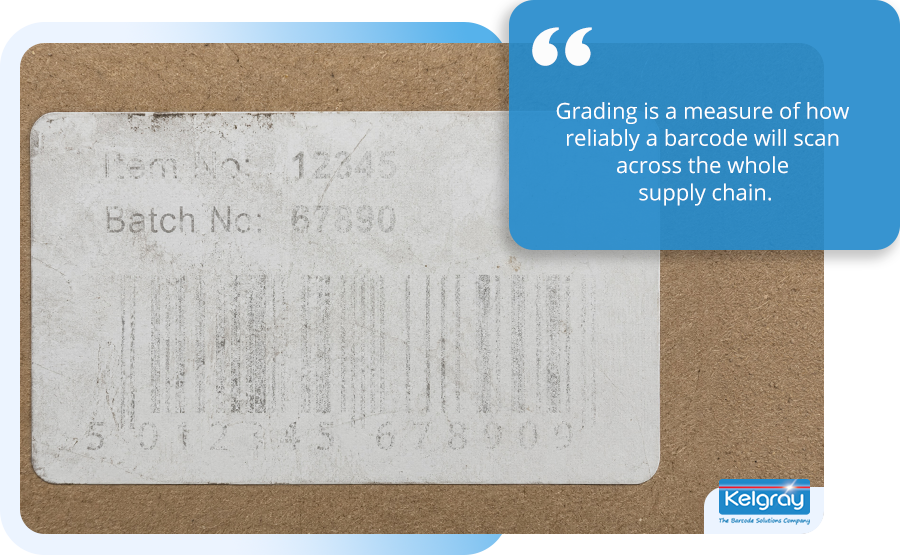
Barcodes are graded for print quality on a scale from A down to F under two ISO/IEC standards, and most major UK retailers require a minimum of Grade B. The grade is not about whether a barcode scans once on your own scanner in good conditions; it is a measure of how reliably it will scan across the whole supply chain, on different equipment, at speed, after handling. A barcode that grades poorly is a barcode that will eventually fail at a customer’s goods-in.
The grading standards split by barcode type. Linear, one-dimensional barcodes such as Code 128 and EAN are graded under ISO/IEC 15416, which assesses a set of parameters across multiple scan lines taken up the height of the code and averages them into a single grade. Two-dimensional barcodes such as Data Matrix and QR Code are graded under ISO/IEC 15415, which checks parameters specific to 2D symbols. Both produce a result on the familiar A to F scale, where Grade A is effectively a perfect print and Grade F is a fail. Retailers and logistics networks commonly set Grade B, sometimes Grade C, as the minimum a supplier must meet, and some ask for a verification certificate as evidence.
Grade is influenced by things that are easy to get wrong on a busy line: the contrast between bars and spaces, the sharpness of the bar edges, the absence of voids or ink spread, and the quiet zones, the clear margins on either side of the code that scanners need to find its edges. Quiet zones are mandatory, and crowding a barcode with other print is one of the most common causes of a downgrade. The choice of label material and ribbon matters too, because a substrate that lets ink spread, or a ribbon mismatched to the surface, will pull a grade down even when the artwork is perfect.
The reliable way to guarantee grade on an automated line is verification. A machine-vision system mounted at or after the labelling head reads every code as it is applied and checks it against the required grade, flagging or rejecting anything that falls short before it leaves your building. That changes barcode quality from something you sample and hope, to something you confirm on every unit and can evidence to a customer. Where a single failed pallet means a deduction or a rejected delivery, that verification usually pays for itself quickly, and it is the natural answer to a retailer that demands a minimum grade. We cover this in our machine vision solutions section, and we match the label materials and ribbons to the surface and the grade as part of the same job. That matching is not guesswork: when one customer’s labels would not adhere fully to fabric bags, we trialled adhesives against the surface itself until a suitable one was found, and the labels held from then on. An awkward substrate rarely rules labelling out; it means the consumable must be chosen for the surface it will live on rather than picked from a general list.
4. Does my product need an SSCC, and where does the pallet label go?
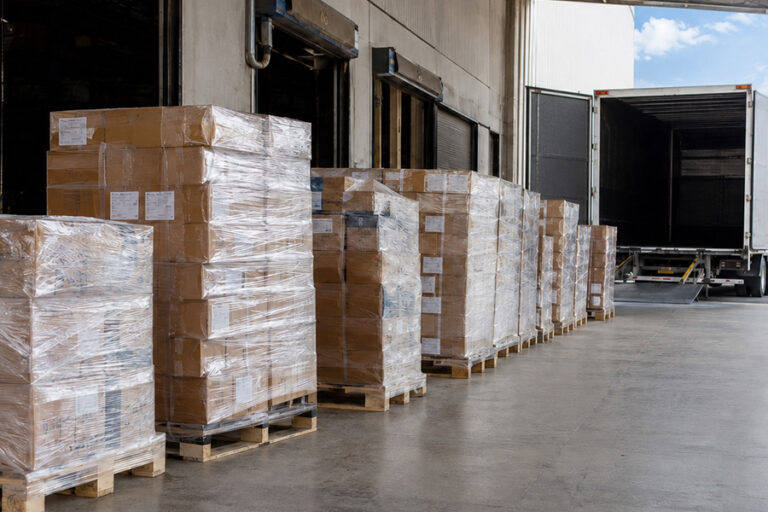
Your product needs an SSCC whenever it ships as a logistics unit, a pallet or a case, that has to be identified and tracked through the supply chain, which in practice means almost any pallet going into UK retail or third-party logistics. The SSCC is carried on a GS1 logistics label, and GS1 sets clear rules for where that label is placed, because a code in the wrong position is as good as no code when a forklift driver or a fixed scanner cannot read it.
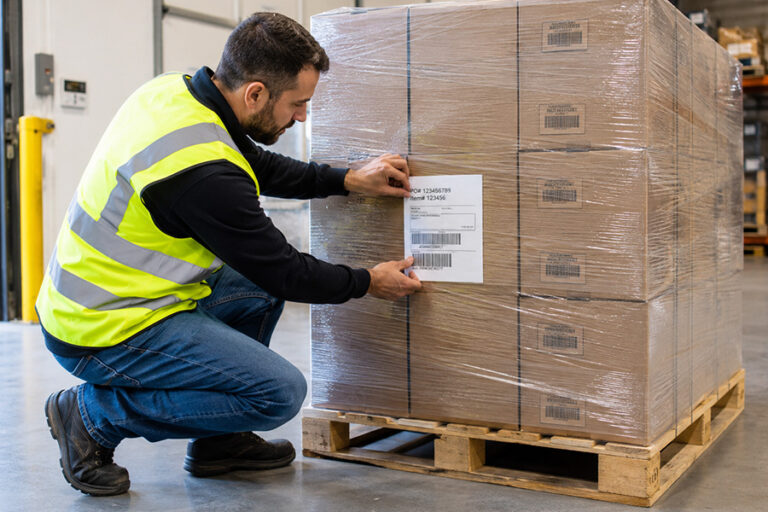
The GS1 logistics label carries the SSCC in a GS1-128 barcode, usually alongside human-readable text and often other Application Identifier data such as the GTIN of the contents, batch, and date. GS1 sets clear placement rules so that handheld and fixed scanners can find the code consistently:
- Height band: on pallets over 400 mm high (virtually all standard pallets), the barcode sits no higher than 800 mm and no lower than 400 mm from the base; on units under 400 mm high, the label goes as high as practical.
- Bar height: the barcode is at least 32 mm tall.
- Orientation: upright, in the “picket-fence” orientation with the bars vertical.
- Quiet zones: kept no closer than 50 mm to a vertical edge.
- Two barcodes: where a label carries two, the SSCC sits in the lower one.
- Coverage: labels are commonly applied to two adjacent faces so a code is visible from more than one approach.
These figures come from GS1’s logistics label guidance and are echoed in the supplier specifications that UK supermarkets publish, which may add their own requirements on top, such as a minimum barcode grade, specific label sizes, or verification certificates. The sensible approach is to design to the GS1 baseline and then check each customer’s own supplier guide for anything stricter, rather than assuming one retailer’s rules cover them all.
| UK pallet and label rules worth pinning
• Pallet barcodes belong in a band 400 to 800 mm above the base, on pallets more than 400 mm high (GS1 guidance). • Most major UK retailers want Grade B print quality or better, measured under ISO/IEC 15416. • Mandatory food-label text must be at least 1.2 mm in x-height under the Food Information Regulations. |
This is the area where automated print and apply makes the clearest difference. A print and apply system generates the SSCC, prints the label with the correct data drawn from your warehouse system, and applies it to the same position on every pallet, which is precisely the consistency the placement rules demand and the hardest thing to achieve by hand. For an operation being judged on goods-in compliance, that repeatability is the difference between an occasional rejection and a process you can stand behind.
| Failing a retailer’s goods-in over pallet labels?
Tell us which retailer, what is being rejected, and how you label today, and we will help you map the GS1 and retailer rules to a print and apply setup that holds them. Speak with a specialist. |
5. What does food labelling law require, and what is Natasha’s Law?
UK food labelling is governed primarily by the Food Information Regulations 2014, which enforce the retained Food Information to Consumers rules and set out the mandatory information every prepacked food must carry. On top of that sits Natasha’s Law, which since 1 October 2021 has required full ingredient and allergen labelling on food that is prepacked for direct sale.
The Food Information Regulations 2014 were made on 14 July 2014, with their substantive consumer-information provisions coming into force on 13 December 2014, and they give UK authorities the means to enforce the consumer-information rules. For a prepacked food, the mandatory information a label must carry is:
- the name of the food;
- a full ingredients list, with any of the 14 regulated allergens emphasised within it;
- the net quantity;
- a date of minimum durability (“best before”) or a “use by” date;
- any special storage or use conditions;
- the name and address of the food business.
The regulations also set a minimum legibility standard: the mandatory text must use a font with an x-height of at least 1.2 mm, dropping to 0.9 mm only on the smallest packs whose largest surface is under 80 square centimetres. Allergen emphasis must make the allergen stand out from the rest of the ingredients, and can be shown in any of these ways:
- bold type;
- capital letters;
- a contrasting colour;
- The 2014 Regulations apply in England, with equivalent regulations operating in Wales, Scotland, and Northern Ireland, and the content obligations are substantively the same across all four nations because each enforces the same retained EU rules.
Natasha’s Law extended the full-labelling requirement to a category that previously needed less: food prepacked for direct sale, known as PPDS. This is food packed on the same premises from which it is sold, such as a sandwich made and wrapped in a shop to be sold from that shop’s counter.
Since 1 October 2021, PPDS food in England, Wales, and Northern Ireland must carry the name of the food and a full ingredients list with the 14 allergens emphasised, the same as any other prepacked food, with equivalent rules in Scotland. The law followed the death of Natasha Ednan-Laperouse from an allergic reaction to a product that carried no allergen information, because a then-legal loophole exempted freshly made, premises-packaged food from full ingredient labelling, and enforcement is handled by local authority environmental health and trading standards officers.
In March 2025 the Food Standards Agency went further in its guidance for England, Wales, and Northern Ireland, encouraging the out-of-home sector to provide written allergen information for food that is not prepacked at all, such as loose items sold over a counter, a direction of travel worth watching even though it is guidance rather than law. Scotland is covered separately by Food Standards Scotland.
The practical challenge food labelling sets an automated line is variable data. Every product can have a different ingredients list, a different set of allergens to emphasise, and a different date code, and getting the wrong list on the wrong pack is both a legal failure and a safety risk. Printing on demand, with the label data driven from a recipe or product database, is what makes per-product accuracy achievable at line speed, and it is far safer than holding stocks of pre-printed labels that can be applied to the wrong product. The date and batch coding that goes alongside it sits in the same family of work, which is why food customers often combine labelling with coding and marking on the same line.
6. How are chemicals labelled under GB CLP?
Chemicals supplied in Great Britain are labelled under the GB CLP Regulation, the domestic version of the international system for classifying, labelling, and packaging hazardous substances. GB CLP follows the United Nations Globally Harmonised System, so the labels look familiar, but since leaving the EU the UK maintains and updates the rules independently through the Health and Safety Executive, which means a UK supplier must work to the GB list rather than the EU one.
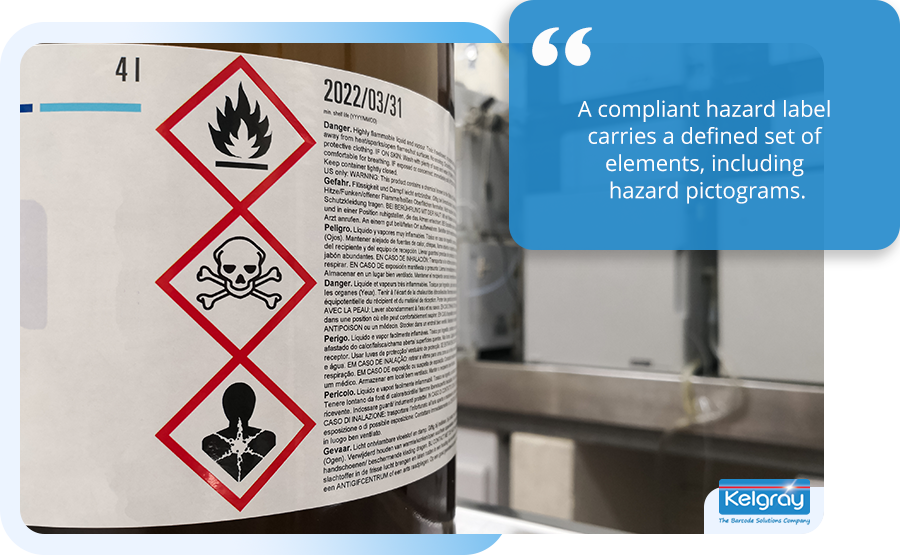
A compliant hazard label under GB CLP carries a defined set of elements, and missing any one of them makes the label non-compliant:
- the product identifier;
- the name and contact details of the supplier;
- one or more hazard pictograms: the recognisable red-diamond symbols (a black image on a white background), nine in the GHS set, covering hazards such as flammability, toxicity, corrosivity, and harm to health or the environment;
- a single signal word: either “Danger” for the more severe hazard categories or “Warning” for the less severe, with only one on a label, matching the most serious hazard present;
- the hazard statements (H-codes): a description of the nature of the hazard;
- the precautionary statements (P-codes): how to handle the substance safely.
A point that catches suppliers out is jurisdiction. GB CLP applies in England, Scotland, and Wales, while Northern Ireland continues to follow the EU CLP Regulation under the Windsor Framework, so a business supplying across the whole of the UK may need to satisfy two regimes. The classifications themselves also move: the HSE maintains a GB Mandatory Classification and Labelling list and updates it in periodic editions, with the sixth edition issued in February 2025 and the seventh in September 2025, between them revising the classification of dozens of substances. A label that was correct last year can be wrong this year if one of its substances has been reclassified.
For an automated or coding-and-marking line, the lesson is that chemical labels must be both correct and easy to update. When a classification changes or a pictogram must be added, an on-demand printing setup lets you update a label template centrally and have the new version print from the next run, where a business relying on pre-printed label stock has to scrap and reorder. Holding the artwork digitally, and printing each label as it is needed, turns a regulatory change from a stock write-off into a template edit.
7. Are UK medical-device UDI rules in force yet?
Not yet. If you make medical devices, Unique Device Identification (UDI) is on its way, but it is not a firm legal requirement in Great Britain today, so there is nothing you must do this minute. What is worth doing now is building the kind of reliable, traceable barcoding the rules will expect, because that is a safe move whether the dates arrive sooner or later.
UDI is simpler than it sounds. It means giving each device a standard identifying number and putting that number in a barcode, so the device can be traced through the supply chain and back to its maker if a problem ever arises. In Great Britain, medical devices are overseen by the Medicines and Healthcare products Regulatory Agency, the MHRA, rather than by the US or EU regulators, so take care with guidance you find online: a lot of it describes the American or European UDI systems, which are further ahead, and those rules do not automatically apply here.
The state of play, in short, is that the MHRA is reforming the UK rules and bringing in UDI in stages, with phase-in periods of around three years for general devices and five years for in vitro diagnostic devices once the requirements are set, and draft regulations were published in mid-2026. Because the detail is still settling, treat any specific date or duty as provisional and check the current MHRA guidance before you rely on it.
The practical part is reassuring. A UDI label usually carries a GS1 identifier such as a GTIN in a Data Matrix or a standard barcode, the same standards covered earlier in this guide. So a manufacturer getting ready for UDI is mostly just putting good, verifiable barcoding in place, which is what a well-set-up automated line does anyway. Build a line that can print a clean Data Matrix to grade, with the device number and production data drawn from your systems, and you are ready for the requirement as it firms up, without betting on a date that has not landed.
8. What about healthcare and NHS Scan4Safety?
Healthcare in the UK has its own strong pull towards GS1 barcoding through the NHS Scan4Safety programme, which applies GS1 standards across the patient pathway to improve safety and traceability. If you supply products or services into the NHS, Scan4Safety is the framework that shapes how your items must be identified, and it is increasingly a condition of doing business rather than an optional extra.
Scan4Safety uses the same GS1 identifiers found elsewhere in this guide, the GTIN to identify a product, the Global Location Number to identify a place, and the SSCC for logistics units, so that products, people, and places can all be scanned and matched at the point of care. A government mandate called for NHS England trusts to adopt barcode scanning of high-risk medical devices, with milestones through to March 2024, and the programme has continued to expand, with national programmes established in Scotland and Wales. Adoption across English trusts has been growing from a base of roughly a third having implemented GS1 standards as of 2023, around the programme’s relaunch.
For suppliers, a concrete recent change is the date-format requirement: from January 2025, barcodes on regulated healthcare products must encode expiry dates in a fully compliant format under the GS1 General Specifications, removing an older allowance to use a placeholder for the day of the month.
The practical implication mirrors the rest of this guide. Supplying into healthcare means encoding the correct GS1 identifiers, in the right symbology, to a reliable print quality, on labels and on items such as patient wristbands where durability and scannability matter at the bedside.
We supply patient wristbands and healthcare labelling built to these standards, and the same principles of on-demand, verified printing that serve a food or logistics line serve a healthcare one. On the device side, we supplied an automated line for a medical-device manufacturer supplying sterilised surgical instruments and accessories, printing and labelling pouches of differing sizes on demand. The customer ran a legacy label format, so rather than impose a new one we matched the line’s output to their existing format and the compliance requirements attached to it, which is often the right approach when a format is already embedded in a customer’s own quality process.
9. What does a labelling mistake cost?
A labelling mistake costs far more than the label, because the price is paid downstream where it is hardest to fix, and in regulated sectors it can escalate from a deduction to a recall. The same error that costs pennies to prevent at the line can cost a rejected delivery at a customer’s gate, a regulatory penalty, or a full product withdrawal once it reaches the public.
The everyday cost is the retailer deduction. UK supermarkets run supplier-compliance schemes that allow them to deduct money, or reject a delivery outright, when labels do not meet their rules, whether that is an unscannable or low-grade barcode, a missing or misplaced GS1-128 pallet label, or the wrong code on a unit. Published chargeback schedules tend to come from US retailers, so we are careful not to quote a dollar figure as if it were a UK one; the major UK grocers operate their own deduction schemes and rarely publish the rates. What we can say plainly is that non-compliant labelling carries a real, recurring, per-occurrence cost in UK retail supply, and it is exactly the kind of error a verified automated label is built to prevent.
We have seen this from the inside. One customer came to us being charged £500 for every pallet a large UK supermarket chain rejected, and the failures kept recurring because nothing on the line confirmed a label was right before it shipped. The fix was verification at both points where a label was produced: fixed-position check scanning on the automated line, and handheld check scanning for the labels still printed manually. With every label checked before it left the building, the charges fell to zero, and the customer could show the retailer that each pallet had been confirmed compliant on the way out. The figure will vary by retailer and by scheme, but the pattern holds: the cost stopped when compliance became something the line proved rather than assumed.
The serious end of the scale is the regulatory failure and the recall. A mislabelled allergen on a food pack, a wrong hazard pictogram on a chemical, or a device that cannot be traced is not a commercial inconvenience but a safety and legal matter, enforced by the FSA and local authorities, the HSE, or the MHRA depending on the product. A recall carries the cost of recovering and destroying stock, halting production, investigating, and reprinting, along with reputational damage that outlasts the incident and the loss of a customer’s confidence. For a food or pharmaceutical business, this single risk often justifies investment in automated, verified labelling on its own.
There is a humbler pattern behind many of these failures. Across the sites we visit, we put roughly nine in ten of the labelling-compliance problems we are called out to down to poor standard operating procedure or missed maintenance, rather than to the rules themselves. The classic case is the printhead that never gets cleaned: dots clog, then burn out, and from that point every label carries a thin line through the text and the barcode until a goods-in scanner fails it. That is our own field estimate from the sites we work on, but it holds up well enough that a cleaning and maintenance routine is one of the first things we examine when a customer reports compliance trouble.
| ⚠ Where labelling compliance goes wrong most often
• A barcode printed below the customer’s required grade, failing at goods-in even though it scanned in your own warehouse • A pallet label placed outside the GS1 height band, or with its quiet zones crowded, so fixed scanners miss it • An allergen missed or not emphasised on a PPDS food label, a safety failure as well as a legal one • A chemical label using an out-of-date classification after the GB MCL list was revised • A printhead not cleaned to schedule, so blocked and burnt-out dots leave lines through the print and the barcode • A label material or ribbon mismatched to the surface, pulling the barcode grade down over time • Records that cannot evidence which label went on which batch when a customer or regulator asks |
10. How does an automated system help you stay compliant?
An automated print and apply system helps you stay compliant by removing the two things that cause most labelling failures: human variability and pre-printed inflexibility. It prints the right data on demand for each item, applies the label to the same position every time, can verify the result, and keeps a record of what it did, which together turn compliance from a daily effort of attention into a property of the line itself.
Take those in turn, because each maps to a rule covered above. Printing on demand means the variable information, the ingredients and allergens for a food pack, the SSCC and batch for a pallet, the hazard statements for a chemical, the device identifier for a medical product, is drawn live from your systems and printed correctly for that specific item, rather than keyed by hand or pulled from a tray of pre-printed stock that can be applied to the wrong thing. Consistent application means the label lands in the same place at the same orientation on every unit, which is what the GS1 placement rules require and what hand application struggles to hold across a shift. Verification, through machine vision, means each barcode is read and confirmed to grade as it is applied, so a sub-standard code is caught before it ships rather than discovered at a customer’s goods-in. Record-keeping means the system can log what was printed and applied, giving you the traceability that both retailers and regulators increasingly expect.
There is a quieter benefit that matters as much as any single rule: change. Standards and specifications move, as the GB CLP classification updates, the healthcare date-format change, and the coming shift to 2D barcodes all show. An on-demand system lets you update a label template centrally and have the change take effect from the next run, where a pre-printed approach means scrapping and reordering stock every time a rule moves. In a regulatory environment that keeps changing, the ability to update once and print correctly from then on is a real and recurring saving.
Many of our customers do not make those updates themselves at all. Where a customer allows it, we connect remotely to the controlling PC or the line’s HMI (its human-machine interface panel) and make the label change for them; alternatively, we make the alteration in-house and send back the updated format ready to load. Either way, a rule change becomes a small piece of support work rather than a project.
| Step 1
Identify the rules that apply |
Step 2
▶ Build the right data |
Step 3
▶ Set the print quality and grade |
Step 4
▶ Verify every label |
Step 5
▶ Keep the records |
Those five steps are the backbone of a compliant automated label. Identify the rules that apply to your product and customer, the barcode standards plus the relevant sector law, before you specify anything. Build the right data by connecting the line to the systems that hold your product, batch, and date information, so the label prints from a trusted source. Set the print quality and grade the label must meet, choosing the symbology, the label material, and the ribbon to hold it. Verify every label with machine vision where the cost of a failure justifies it. Keep the records so you can evidence compliance when a customer or regulator asks. Designing these in from the start is far cheaper than retrofitting them after a failure.
11. How do you build compliance into a labelling system from the start?
You build compliance in by treating the standards as part of the specification, not as something to check at the end. The cost of meeting a rule is small when it shapes the design of the line and large when it is discovered after the line is running, so the work belongs at the scoping stage, alongside speed and throughput.
In the systems we commission for retailer-facing and regulated customers, the pattern that works is to start from the strictest requirement the line will ever have to meet, rather than the average one. If one of your customers demands Grade B barcodes with a verification certificate, design for that and the easier customers are covered automatically. If one of your products falls under PPDS allergen rules, build the data feed that prints full ingredient lists per product, and the simpler products use the same mechanism. The same logic applies to materials: choosing a label and ribbon that hold their grade on your most difficult surface, in your coldest or wettest condition, means the rest of your range is comfortably within tolerance.
12. Key terms at a glance
The glossary below collects the standards, identifiers, and terms used through this guide, for quick reference.
| Term | What it means |
| GTIN | Global Trade Item Number, the unique number identifying a product, licensed through GS1 UK |
| SSCC | Serial Shipping Container Code, the unique number identifying a single pallet or case |
| GS1-128 | The logistics barcode (a Code 128 using GS1 Application Identifiers) that carries the SSCC and related data |
| GS1 General Specifications | GS1’s master rulebook for identifiers, barcodes, and data |
| ISO/IEC 15416 | The standard for grading the print quality of linear (1D) barcodes, A to F |
| ISO/IEC 15415 | The standard for grading the print quality of 2D barcodes such as Data Matrix and QR Code |
| Code 128 / Data Matrix / QR Code | Barcode symbologies, specified in ISO/IEC 15417, 16022, and 18004 respectively |
| Barcode grade | A printed barcode’s scannability scored A to F; UK retailers commonly require Grade B |
| Quiet zone | The clear margin on either side of a barcode that scanners need to read it |
| PPDS | Prepacked for direct sale, the food category covered by Natasha’s Law since 1 October 2021 |
| Food Information Regulations 2014 | The UK regulations setting mandatory food-label information |
| GB CLP | The Great Britain regulation for classifying and labelling hazardous chemicals, based on the GHS |
| GHS pictogram | A red-diamond hazard symbol used on a chemical label |
| UDI | Unique Device Identification, the medical-device traceability system being phased in by the MHRA |
| Scan4Safety | The NHS programme applying GS1 standards across the patient pathway |
13. Frequently asked questions
What labelling regulations apply in the UK? It depends on your product, but almost every operation must meet barcode and data-carrier standards from GS1 and ISO/IEC, then add the sector rules that fit: food labelling under the Food Information Regulations and Natasha’s Law, chemicals under GB CLP, medical devices under the MHRA, and healthcare identification through NHS Scan4Safety. Most UK products carry a barcode plus at least one sector content rule, and regulated sectors carry several at once.
What is GS1-128 and when do I need it? GS1-128 is the logistics barcode used on pallets and cases. It is a Code 128 barcode that uses GS1 Application Identifiers to carry structured data such as the Serial Shipping Container Code, batch number, and best-before date. You need it whenever you ship logistics units into UK retail or third-party logistics, because it is how a pallet or case is identified and tracked through the supply chain and is required by most major retailers at goods-in.
Does my product need an SSCC? Your product needs a Serial Shipping Container Code whenever it ships as a pallet or case that must be identified and tracked through the supply chain, which covers almost any pallet going into UK retail or logistics. The SSCC is a unique licence-plate number for that specific unit, carried in a GS1-128 barcode on the logistics label, and placed within GS1’s defined height band so scanners can find it reliably.
What is Natasha’s Law and does it affect automated lines? Natasha’s Law has required, since 1 October 2021, that food prepacked for direct sale carries the name of the food and a full ingredients list with the 14 regulated allergens emphasised. It affects automated lines mainly through variable data: each product needs its own correct ingredients and allergens printed accurately, which on-demand printing from a product database handles far more safely than pre-printed label stock.
What barcode grade do UK retailers require? Most major UK retailers require a minimum of Grade B, with some accepting Grade C and some asking for a verification certificate as evidence. Grade is measured under ISO/IEC 15416 for linear barcodes and ISO/IEC 15415 for 2D barcodes, on a scale from A to F. The reliable way to hold a grade on an automated line is machine-vision verification, which reads and confirms each barcode as it is applied.
Are UK medical-device UDI rules in force yet? Not as a settled mandate. Unique Device Identification is being introduced through the MHRA’s phased reform of UK medical-device regulation, with transitional periods and statutory instruments still progressing. The direction is clear and building traceable barcoding now is sensible, but the specific obligations and dates should be checked against current MHRA guidance rather than treated as fixed, and US or EU UDI rules should not be assumed to apply in Great Britain.
14. How Kelgray helps you stay compliant
Keeping a label compliant is not one job but a chain of them: the data, the barcode grade, the material, the placement, and the records. We built our service to cover the whole chain rather than a single link. We design, integrate, supply, and support automated labelling as one route: the print and apply system, the label materials and ribbons matched to your surface and grade, the coding and marking that carries your dates and batches, and the machine-vision checks that prove each barcode scans. Because those parts come from one partner, they are matched to each other and to the standard you have to meet, instead of being reconciled across separate suppliers after something has already failed.
We are not a substitute for the official guidance, and for the detail of any rule you should always check the primary source, GS1 UK, the FSA, the HSE, the MHRA, or the relevant standard. What we can do is translate those rules into a labelling line that meets them reliably and keeps meeting them as they change. Whether you are scoping a new system or trying to fix a compliance problem on an existing one, the quickest way forward is to walk us through your products, your customers, and the standards you answer to, and let us map them to a line that holds up.
We are a UK family-owned business that has done this since 1972, our own processes are certified to ISO 9001 and SafeContractor.There is more about us and the sectors we serve on our site.
| Speak with a specialist about labelling compliance
Tell us what you make, who you supply, and the standards you are judged against, and we will help you build or fix an automated labelling line that meets them and keeps meeting them as the rules change. Speak with a specialist. |
Sources
- GS1 UK, “Where should pallet labels be placed?” (the 400 to 800 mm barcode height band for pallets over 400 mm high, 32 mm minimum bar height, quiet-zone and orientation guidance); GS1, GS1 Logistic Label Guideline.
- GS1 UK and GS1 General Specifications, GTIN, SSCC, GS1-128 and Application Identifier guidance; GS1 UK guidance on minimum requirements for inbound logistics and retailer compliance.
- ISO/IEC 15416 (linear barcode print-quality grading) and ISO/IEC 15415 (2D barcode print-quality grading), ISO.
- ISO/IEC 15417 (Code 128), ISO/IEC 16022 (Data Matrix), ISO/IEC 18004 (QR Code) symbology specifications, ISO.
- Food Standards Agency, “Allergen labelling changes for prepacked for direct sale (PPDS) food” and PPDS labelling guidance (Natasha’s Law, in force 1 October 2021; 14 regulated allergens; March 2025 best-practice guidance on non-prepacked food for England, Wales, and Northern Ireland).
- The Food Information Regulations 2014 (SI 2014/1855), legislation.gov.uk (made 14 July 2014, substantive provisions in force 13 December 2014); Food Standards Agency packaging and labelling guidance (mandatory information; 1.2 mm minimum x-height).
- Health and Safety Executive, “The GB CLP Regulation” and chemical classification and labelling guidance (GHS pictograms, signal words, H and P statements; GB Mandatory Classification and Labelling list, 6th edition February 2025 and 7th edition September 2025).
- Medicines and Healthcare products Regulatory Agency / GOV.UK, reforms to UK medical-device regulation and Unique Device Identification approach (transitional periods of three years for general devices and five years for IVDs; UKCA marking and UDI database); independent legal analyses of the MHRA timeline (Burges Salmon, DAC Beachcroft, 2025–2026).
- NHS Scan4Safety and GS1 UK, application of GS1 standards across the patient pathway; 2023 mandate on NHS England barcode scanning of high-risk devices by March 2024 (around a third of English trusts adopted as of 2023); GS1 UK change of date format for regulated healthcare products from January 2025.
- ISO 9001:2015 quality management systems, ISO; SafeContractor (Alcumus), SSIP health-and-safety accreditation.