



By the end of 2027, retailers around the world have committed to making their point‑of‑sale systems capable of scanning 2D barcodes — typically QR codes carrying GS1 Digital Link data, or Data Matrix codes — alongside the 1D UPC and EAN barcodes that have ruled the till since 1974. The initiative is called Sunrise 2027, and it is led by GS1, the global standards body that issues the barcode numbers (GTINs) every product in regulated retail relies on.
If you sit on the brand‑owner, contract‑packer, manufacturer or supply‑chain side of that till, Sunrise 2027 is not a future problem. The till is the last stage in a chain that begins with pack artwork, runs through coding and marking equipment on a production line, and passes through every warehouse scanner before a product reaches a retailer’s distribution centre. Every one of those stages has to be 2D‑ready before the till is. This guide explains, in plain English, what is happening, what it changes for UK operations, what you can ignore, and the concrete steps to take in 2026 and 2027.
We have written it for the people who actually have to do the work: packaging managers, production engineers, quality and compliance leads, supply‑chain and logistics directors, and the IT teams that have to make warehouse systems read codes they have never read before.
What Sunrise 2027 is — and who set it
Sunrise 2027 is a global commitment, coordinated by GS1, to enable retail point‑of‑sale systems to scan 2D barcodes in addition to the linear EAN/UPC barcodes that currently sit on almost every retail‑ready pack in the UK. The deadline GS1 has put on the public record is the end of 2027.
Sunrise 2027 is not a piece of UK or EU legislation, and there is no government regulator that will fine a retailer for missing it. It is an industry alignment target — retailers, brand owners, GS1 and the wider standards community have agreed that by the end of 2027 the global retail system should be able to handle 2D, even where 1D is still the primary symbology on pack. The pressure to comply is commercial rather than legal, but the commercial pressure is significant: brand owners want a single barcode that can do more than scan at the till, and retailers want the operational benefits (date‑coded markdowns, allergen recalls, batch traceability) that a 2D barcode unlocks.
Three groups will feel this most directly. First, retailers and grocers, who have to update till hardware and software. Second, brand owners — anyone who designs and sells a product on a retail shelf — who decide what carrier ends up on the pack. Third, the operations and packaging supply chain that sits between the two: contract packers, label converters, coding and marking specialists, and the warehouses that move stock between brand and retailer.
What changes — and, more importantly, what doesn’t
The clearest single piece of guidance we can give is this: your existing EAN‑13, EAN‑8 and UPC‑A barcodes do not stop working at the end of 2027. They remain valid GS1 identifiers. You can keep printing linear barcodes on packs after the deadline; many products will continue to do so for years. Sunrise 2027 is additive — it adds 2D capability to the till, it does not retire 1D from the pack.
What is changing is the range of what the till can read, and therefore what the till can do. Once a checkout scanner is 2D‑capable, the barcode on a pack can carry information beyond just a product identifier. Date codes, batch numbers, serial numbers, country of origin, allergen flags and a URL pointing to richer product information can all sit inside the same 2D code. The till uses what it needs; everything else can be exposed to the consumer when they scan the same code with their phone, or to the warehouse system when the product is received.
The strategic reframe for operations teams is simple. The 1D barcode is a number — a GTIN, printed as bars. The 2D barcode that Sunrise 2027 envisages is a structured piece of data that includes the GTIN plus everything else you want a scanner to know about that particular unit. That sounds incremental on paper, but in practice it fundamentally changes what packs can do downstream of the production line.
The two 2D carriers you need to know about
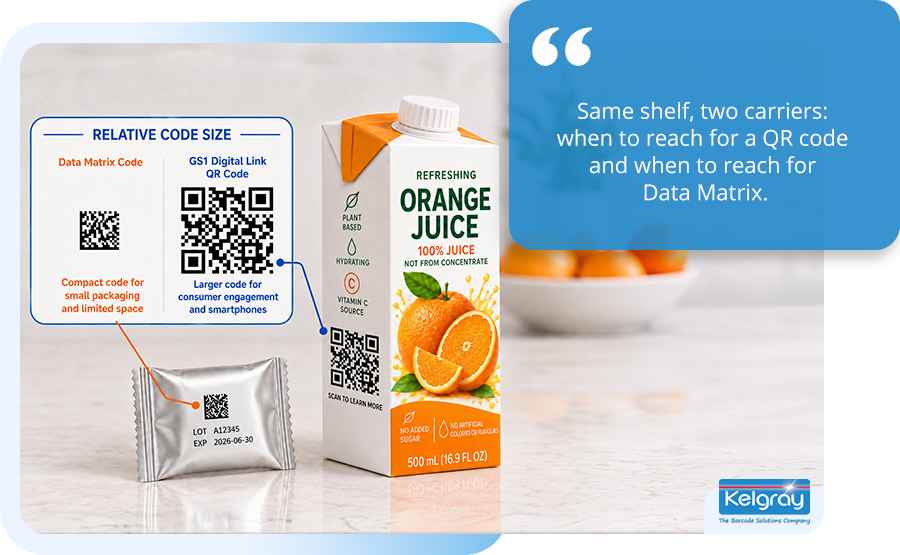
There are two 2D barcode formats in scope for Sunrise 2027, and they do different jobs.
The first is the QR Code carrying a GS1 Digital Link URI. This is the format GS1 is most actively pushing for consumer‑facing packs. A GS1 Digital Link looks like a web address — for example, https://id.gs1.org/01/05012345678900/10/ABC123/21/SN42 — but it is structured so that the GTIN, batch and serial number sit inside the URL in a way that a retail POS scanner can extract directly. At the till it behaves like a barcode. On a consumer’s phone it resolves through a GS1 resolver to whatever destination the brand owner chooses: a product page, an allergen warning, a recycling instruction, a how‑to video. One code, many audiences.
The second is the Data Matrix code. Data Matrix is a denser 2D symbology already widely used on prescription medicines (under the Falsified Medicines Directive and its UK successor), variable‑data fresh produce, and small components. Data Matrix is the practical choice when the printable area is tiny — a foil pouch, a bottle‑neck label, a blister pack — because it packs more data into a smaller mark than a QR code. It can carry the same GS1 application identifiers (GTIN, batch, expiry, serial) and can also encode a Digital Link URI.
Both are valid for Sunrise 2027. The question for a brand owner is not “which one is correct” but “which one fits the pack and the use case”. Consumer‑facing food and drink with a marketing story tends to favour QR. Pharmaceuticals, healthcare consumables, fresh produce and many industrial parts tend to favour Data Matrix. A pack can carry both, and during the transition many will.
What none of this has to do with is the conventional marketing QR code you have been printing on packs since 2010. A marketing QR is just a static link. It is not structured, it does not carry your GTIN, and a POS scanner has no way to extract a price‑look‑up from it. If your pack design currently includes a marketing QR, expect to replace or upgrade it to a Digital Link QR over the next eighteen months.
Decision tree: which 2D barcode is right for your pack?
A simple way to choose the right carrier is to work through the questions in the order they appear on the production line. We have laid that out as a decision tree below.
|
Step |
Question | If yes → |
If no → |
| 1 | Is this product sold at retail through a scanned till? | Continue to step 2 | A 2D barcode is optional for traceability / internal use; consider Data Matrix on the case label only |
| 2 | Is the printable area on the consumer pack less than ≈20 mm square? | Use Data Matrix (denser); confirm minimum X‑dimension with your supplier | Continue to step 3 |
| 3 | Will the consumer be encouraged to scan the code with a phone for information, recipes, recycling, allergens or marketing? | Use GS1 Digital Link QR (consumer‑friendly) | Continue to step 4 |
| 4 | Is the product regulated (pharma, medical device, certain foods) with serialisation or batch traceability requirements? | Use Data Matrix carrying GS1 Application Identifiers; in many cases this is already mandatory | Continue to step 5 |
| 5 | Is there variable per‑unit data (best‑before dates, batch or serial numbers) that must change at line speed? | Use on‑line coding and marking (TTO or CIJ) to print Data Matrix or QR; a pre‑printed label is not sufficient | A pre‑printed label is acceptable |
| 6 | Default position if none of the above is decisive | GS1 Digital Link QR on the consumer pack; Data Matrix on case and pallet labels | — |
If you take only one rule away from the tree, take this one: the carrier follows the data, not the marketing brief. If the data needs to change per unit, you need an on‑line coding and marking solution, not a pre‑printed label. That is a production‑engineering decision more than a graphic‑design one.
The transition timeline
A realistic plan for a UK brand owner or contract packer looks something like the schedule below. The dates are indicative — your sector, your retailers and your own packaging cycle will pull some of these earlier and push others later.
|
Period |
Brand owner / packaging | Operations / production line | Warehouse / logistics |
Retail / commercial |
| Now to end of 2026 | Audit current pack artwork; identify SKUs that need a Digital Link QR or Data Matrix; engage GS1 UK and confirm GTIN structure | Confirm coding and marking equipment can print Data Matrix and QR at line speed; replace or upgrade where it cannot; trial print quality on existing substrates | Audit handheld and fixed barcode scanners; confirm 2D‑imager coverage; identify gaps | Engage retail customers; ask which symbology they will scan first; align launch windows |
| 2027 (first half) | Roll out updated pack artwork on new launches and natural redesign cycles; do not redesign packs just for Sunrise | Run dual‑symbology (1D + 2D) production for at least one packaging cycle to de‑risk; validate read rates with retailer DCs | Replace any remaining 1D‑only scanners; configure WMS to parse GS1 Digital Link data and GS1 Application Identifiers | Sign off on customer‑specific 2D readiness with major retailers; capture any retailer‑specific quirks |
| 2027 (second half) | Switch the majority of SKUs to dual‑symbology or 2D‑primary on new print runs | Validate end‑to‑end traceability — code applied on line, read at goods‑in, read at till — for representative SKUs | Update goods‑in, putaway, pick and dispatch procedures to use the additional data (batch, expiry) | Confirm Sunrise 2027 readiness in retailer scorecards; sign off internally |
| 2028 onwards | Continue rolling 2D into the wider catalogue at natural reprint cycles | Begin phasing out dual‑symbology where commercially safe; retain 1D where any non‑2D‑ready route to market exists | Use the richer data for waste reduction, mark‑downs and recall response | Quantify and report business benefits (waste, shrinkage, recall speed) |
A note on cost: very little of the work above is throwaway. Coding and marking equipment that prints Data Matrix today will keep doing so for a decade. 2D‑capable scanners are now the default at almost every price point. Label converters and consumables are unchanged. The real spend sits in pack artwork updates and software integration — and both are best timed against your existing redesign and IT cycles rather than as a separate project.
The regulation that is going to push you faster than Sunrise 2027 will
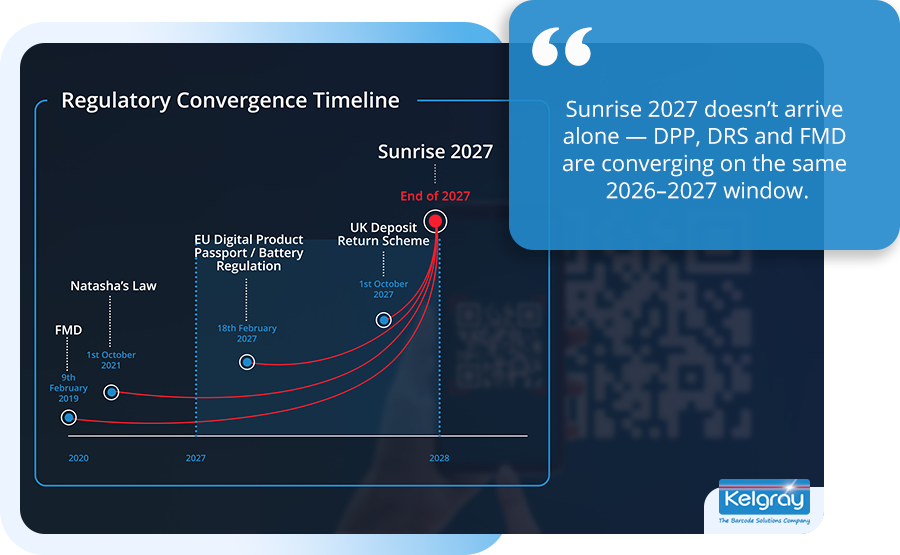
Sunrise 2027 on its own would not justify rebuilding a production line. What turns it into a forcing function is the cluster of UK and EU regulation that arrives in roughly the same window. That regulation depends on the same underlying capability — printing a 2D code with variable data on every unit, and reading it through the supply chain.
The most consequential is the EU Digital Product Passport (DPP), which is being introduced under the Ecodesign for Sustainable Products Regulation. The DPP requires a digital identity on regulated product categories — beginning with batteries from 18 February 2027 under the separate Battery Regulation, then expanding to textiles, electronics, furniture, tyres and others through delegated acts. The DPP is typically delivered via a 2D barcode that links to a regulator‑accessible data set. Even where the UK does not mirror the regulation domestically, any UK manufacturer that exports into the EU is caught.
The UK Deposit Return Scheme for single‑use drinks containers is currently scheduled for October 2027 across England, Northern Ireland and Scotland, with Wales aligning its own scheme to the same date. Each in‑scope container will need a unique identifier, and 2D is the leading carrier candidate.
In food, the cluster of UK labelling reform around allergens (Natasha’s Law and its successors) and origin / traceability is not legally dependent on 2D, but 2D is the only practical way to deliver the volume of information regulators and consumers now expect without filling the entire back of pack.
The implication for an operations leader is that even if Sunrise 2027 is not strictly mandatory, the regulatory neighbours are. You only build the capability once. Build it for Sunrise and you have built it for DPP, DRS, FMD and the food traceability conversations that are coming next.
What “2D-ready” actually looks like on your floor
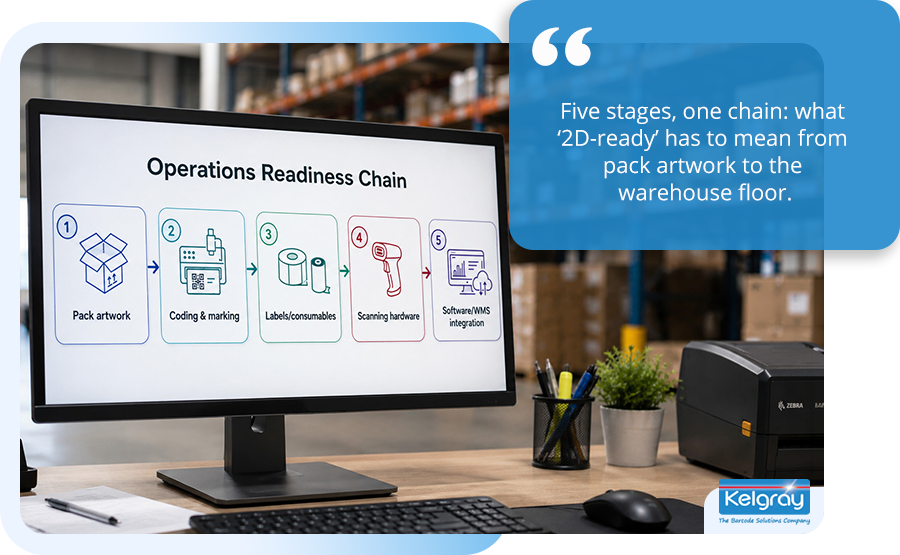
What readiness actually means at each stage of the operations chain is worth spelling out, because every conversation we have with UK manufacturers and contract packers reveals at least one gap nobody had spotted.
Packaging artwork
Readiness means a Digital Link QR or Data Matrix has been added to every retail‑ready SKU’s pack design, with a tested minimum X‑dimension, an acceptable quiet zone, and a confirmed contrast against the substrate. It means the artwork specification document has been updated and signed off by the brand team, the regulatory team and the printer. It also means somebody has decided what the QR resolves to and built that landing experience — because a Digital Link QR with no destination is worse than no QR at all.
Coding and marking
Readiness means your thermal‑transfer overprinters or continuous inkjet printers can produce a readable, grade‑A or grade‑B 2D code at the speed your line runs, with the variable data that needs to change per unit. For many UK lines this is straightforward — modern TTO and CIJ heads will do this without modification — but for older equipment it can mean a replacement printhead, a controller upgrade, or in some cases a new unit. The print‑verification camera that confirms the code is readable matters here too: a 2D code printed badly is invisible to a downstream scanner.
Labels and consumables
Readiness means the labels and ribbons you specify can actually hold a 2D code at the resolution required. Most modern thermal‑transfer label and ribbon combinations are fine, but bright colours, glossy substrates, condensation in chilled supply chains and some adhesives can quietly degrade read rates. It is worth requesting a 2D test print on the actual substrate‑and‑ribbon combination you intend to use, not a stock sample.
Scanning hardware
Readiness means every scanner in the path between your line and the retailer’s till is a 2D imager. Most warehouse and dispatch scanners purchased in the last five years already are; older devices and some legacy fixed‑mount industrial scanners are not. The same is true of the mobile computers and handhelds your operatives use for picking and put‑away.
Software and integration
Readiness is the part that catches most teams by surprise. A 2D‑capable scanner will happily read a Digital Link QR — but unless your warehouse management system, ERP and stock‑control software understand how to parse GS1 Application Identifiers and extract the GTIN, batch, expiry and serial from a Digital Link URI, the scanner has just read an opaque string. The integration work — usually a configuration change rather than a build, but always a piece of work — sits between scanning the code and using the data.
A practical readiness checklist
Use the following as a discussion document with your packaging, operations, warehouse and IT leads. It is not exhaustive, but it covers the questions every UK operations team has to answer before Sunrise 2027 stops being a theoretical conversation.
Brand owners and packaging managers
- Which SKUs need a 2D code on the consumer pack, and on what timeline?
- Have you spoken to your major retail customers about which 2D format they will scan first?
- Is your artwork specification updated with a tested 2D code, quiet zone and minimum X‑dimension?
- Have you decided what the Digital Link URL resolves to, and who owns that experience?
- Is the artwork change scheduled against the natural reprint cycle, not as a separate project?
Production engineers and operations managers
- Can each coding and marking unit on each line produce a readable 2D code at line speed with the required variable data?
- Have you done a print‑and‑read trial on the real substrate, real ribbon and real environmental conditions?
- Is your print verification set up to fail‑stop on unreadable codes?
- Have you scheduled a dual‑symbology (1D and 2D) print window to de‑risk the switch?
- Are the older units on the line scheduled for upgrade or replacement before the 2027 deadline?
Supply chain and warehouse leads
- Is every scanner — fixed and mobile — in the goods‑in, put‑away, pick and dispatch path a 2D imager?
- Is your WMS configured to parse GS1 Application Identifiers?
- Can your stock‑control system store and use batch and expiry data per unit?
- Are your goods‑in procedures updated so receiving operatives know to scan the 2D code, not the 1D, where both exist?
IT and integration leads
- Do your WMS, ERP and any line‑side traceability software understand GS1 Digital Link URIs?
- Where in the data chain does the GTIN‑plus‑batch‑plus‑serial actually live?
- Who owns the connection between a scanned 2D code and the regulatory or customer reporting that may have to flow from it?
- What is the rollback plan if a 2D parsing rule misbehaves in production?
Commercial and account managers
- Which of your major retail customers have asked about Sunrise 2027, and what specifically have they asked you to commit to?
- Have you captured retailer‑specific quirks (preferred URL format, AI list, preferred symbology) in a single source of truth?
- Have you aligned your launch windows with retailers’ own 2D pilot timelines?
Common myths and questions
We hear the same handful of questions on every Sunrise 2027 call. The plain‑English answers are below.
“Do I have to redesign every pack by the end of 2027?”
No. Sunrise 2027 is a retail-till capability deadline, not a pack-redesign deadline. Schedule 2D into your natural artwork redesign cycle. Most brand owners will be substantially 2D by 2028–2030 without ever running a “Sunrise 2027 project”.
“Will my existing EAN-13 barcode stop working?”
Linear EAN and UPC barcodes remain valid indefinitely. Many retailers will continue to scan them as the primary identifier well beyond 2027.
“Is this a UK government deadline?”
No. Sunrise 2027 is an industry commitment coordinated by GS1, not legislation. The forcing functions are commercial pressure from retailers and overlapping regulation in adjacent areas (DPP, DRS, FMD).
“Can I just stick a marketing QR on the pack and call it done?”
A marketing QR is not a GS1 Digital Link QR — it does not carry your GTIN, and a retail POS scanner cannot do anything useful with it. The 2D code that satisfies Sunrise 2027 has to be structured to GS1 standards.
“We already print Data Matrix for pharma — are we already there?”
Mostly, yes — for those SKUs. The capability transfers. But each SKU still needs to be confirmed in the data flow, and consumer-facing packs may want a Digital Link QR in addition to or instead of Data Matrix.
“What about Amazon and other online channels?”
Online channels rely on GTIN under the hood and are largely insulated from the till change. The data structure inside a Digital Link QR is closer to what Amazon and other online catalogues already consume than the 1D barcode ever was — if anything, 2D simplifies the online listing process over time.
Where Kelgray fits
Sunrise 2027 is, ultimately, a question about whether the right code ends up on the right pack, gets read at every scanner in the chain, and feeds the right system. That is operations work, not standards work. The standards have been published; the deadline is fixed; the only remaining question is whether each individual UK brand owner, contract packer and manufacturer has the practical capability on the floor.
Kelgray has spent more than fifty years installing exactly that capability for UK manufacturers — automated print-and-apply labelling for product, pallet, bottle, bag and case formats; coding and marking systems (thermal-transfer overprinters and continuous inkjet) capable of variable-data Data Matrix and QR at line speed; label media and ribbons that hold a 2D code on real-world substrates; 2D-imager scanners and mobile computers across the warehouse; and integration software (including our Stockade stock-control platform and our bespoke integration team) that connects a scanned Digital Link URI to the WMS and ERP systems that actually use the data.
We have written this guide because the SMEs and mid‑market manufacturers we work with deserve a plain English read on the transition, not a vendor pitch dressed as a standards explainer. The substance of what your operation has to do for Sunrise 2027 is independent of who supplies the equipment. But if you have read this far and recognised three or four gaps in your own floor — an older coding and marking unit that will not hit Data Matrix print quality, a fleet of laser-based scanners that do not read 2D, a WMS configuration that has never seen a GS1 Application Identifier — those are exactly the gaps Kelgray has spent fifty four years closing. We would be glad to walk a line with you, audit the equipment, and put a costed readiness plan against your own timeline.
If that is useful, the contact details are below. Otherwise, take the checklist, share it with your operations and packaging teams, and put a date in the diary for a 2D readiness review before the end of Q3 2026. The brand owners who treat the next eighteen months as planning time will be the ones who run a calm 2027.
Plan a Sunrise 2027 readiness review with Kelgray
Book a 90-minute on-site readiness review and we will walk your production and warehouse floor with you, identify every gap between your current setup and a 2D‑ready operation, and hand you a costed, prioritised action plan you keep — whether you choose to work with us afterwards or not. Call 01293 518733, email hello@kelgray.co.uk, or request your free on-site audit — we will be back to you within one working day to confirm a date.
